
Understanding & shaping social cohesion
Recently, there has been a growing feeling that our society is drifting apart. Headlines about polarization, a shift to the right or digital violence are shaping the mood and discussions often escalate faster than we can say “let’s talk”. For us, this is a reason to take a closer look at a topic that is essential for peaceful coexistence: social cohesion.
We talk about what is behind this term, why it is so important, what endangers it and how we can all contribute to strengthening it with small everyday or large-scale commitment.
What does social cohesion mean?

Social cohesion describes the quality of coexistence in a society. According to the Bertelsmann Stiftung’s definition, it is based on three dimensions:
- Social relationships: They are reflected in whether we trust the people around us, whether we can rely on each other in families or circles of friends and whether we accept differences between people.
- Connectedness with the community: It becomes visible when we identify with our city or region, trust institutions such as the courts or media and have the feeling that social decisions are made fairly.
- Orientation towards the common good: This is reflected in whether we stand up for each other, respect the rules of coexistence and everyone has the opportunity to participate in social life, be it in work, housing, leisure or politics.
What threatens social cohesion?
Social cohesion is under more pressure today than ever before. Various developments, from social to global, are putting a strain on coexistence. Some of these have a particularly strong influence:
Social Inequality
Major differences in income, housing and educational opportunities make many people feel that their society is unfair. According to a survey by More in Common, 80% currently see Germany as “rather unfair”, compared to 63% in 2019. The Bertelsmann Stiftung’s social cohesion radar also shows that inequality significantly weakens social cohesion.
Polarisation

Populist actors deliberately stir up “culture wars” and paint a picture of irreconcilable differences between social groups. This weakens trust in each other as well as in democratic institutions and the media. You can find out more about the mechanisms behind this and how they influence our society in our article “What does polarization mean for our society?”.
Digital Developments
Social media and algorithmically controlled content promote radicalization, fake news and digital violence. A BKA study shows that cybercrime and hate crime have risen sharply in recent years. At the same time, algorithms on digital platforms reinforce filter bubbles and make it difficult to establish a common factual basis, a basic prerequisite for social cohesion.
Demographic Shift
Germany is ageing: according to the Federal Statistical Office, more than a third of the population will be over 60 by 2035. This means growing challenges for care, pensions and the labor market, but also for intergenerational cohesion. If young and older people have too few points of contact, the risk of tensions and mutual mistrust increases.
Migration
Migration can enrich a society culturally and strengthen it economically, for example by counteracting the shortage of skilled workers. At the same time, the topic is often instrumentalized in political debates and contributes to polarization. Ultimately, the decisive factor for the influence on social cohesion is whether integration is successful and belonging is promoted. The Federal Agency for Civic Education has put together a page on the topic of migration society that is well worth reading.
Global Crises and Fear of the Future
Climate change, geopolitical conflicts, inflation and the consequences of pandemics are creating uncertainty. The World Economic Forum’s Global Risks Report 2025 shows that more than half of respondents worldwide believe that increasing crises will further exacerbate social tensions and inequalities. These fears are reflected in everyday life and jeopardize cohesion if they are not dealt with constructively.
What is the state of social cohesion in Germany?
Of course, these factors also influence social cohesion in Germany. Recent studies show that polarisation and mistrust have been on the rise recently.
A look at the figures

- According to the Germany Monitor 2024 by the University of Jena 98% of people support basic democratic values and 79% support the constitutional order, but around half of people in East Germany and a third in West Germany are dissatisfied with the way democracy works. Only around a third trust “other people”, and less than 20% rate national cohesion as positive.
- The Social Cohesion Radar 2023 by the Bertelsmann Stiftung also documents a deterioration in cohesion: The index value fell by nine points between 2017 and 2023 (from 61 to 52). Although the level is still considered “solid”, the downward trend is clearly visible.
- A similar picture is painted by a Forsa survey commissioned by DAK-Gesundheit (2025): 61% of respondents currently rate social interaction in Germany as “rather bad” or “very bad”. Around a third have the impression that the situation has deteriorated noticeably in recent years, both in everyday life and in online discussions.
Why is social cohesion important at all?
Social cohesion is key to the future viability of our society. Only when trust, solidarity and participation are strong can democracies become resilient and people feel demonstrably healthier and safer. It also leads to better solutions for common challenges, of which there are currently quite a few.
5 scenarios for possible futures
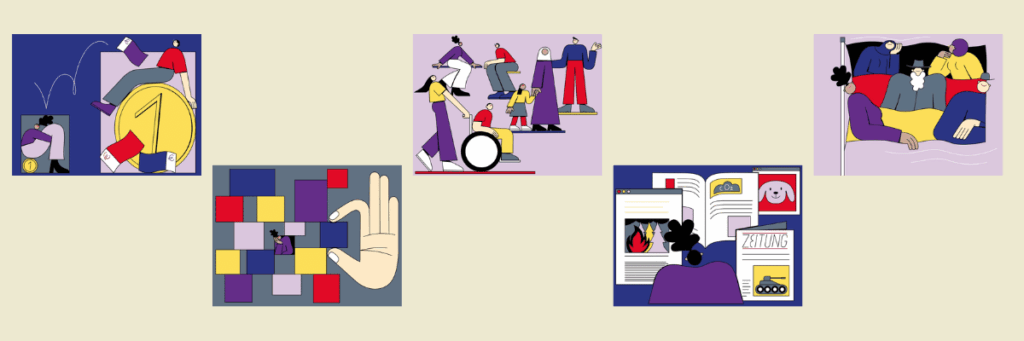
An analysis by the Robert Bosch Stiftung also shows the impact that the quality of social cohesion will have on our future. It outlines five possible scenarios, depending on how social cohesion develops in the future:
Scenario 1 | More Justice
Many people currently feel that Germany is unfair, primarily because of the gap between rich and poor. If this feeling diminishes, for example through affordable housing, falling living costs and fairer distribution, the conviction that we live in a society based on solidarity grows.
Scenario 2 | Less Trust in Politics
Scandals, a lack of transparency and a lack of prospects for the future mean that more and more people are losing trust in politics and institutions. The consequences are lower voter turnout, political apathy and the growing danger that democratic decisions will no longer be accepted.
Scenario 3 | Stronger Social Sommunities
If local meeting places are strengthened, such as community centers, mixed neighborhoods or low-threshold volunteer formats, people can once again experience a stronger sense of community. This creates trust, shared values and greater stability, even across social divides.
Scenario 4 | Turning Away from World Affairs
More and more people are avoiding news because they are burdened by negativity or because digital entertainment options seem more attractive. This threatens to erode the common information base, which considerably weakens understanding and the ability to compromise.
Scenario 5 | Successful Integration of Migrants
Migration can become a strength if immigrants are not only needed economically, but are also seen as part of the “we” in society. If integration is successful in education, work and everyday life, a sense of belonging grows and diversity makes a visible contribution to stability and cohesion.
Which of these scenarios ultimately becomes reality depends on the decisions made by politicians and institutions and the commitment of us all.
6 ideas: How you can help shape social cohesion
Social cohesion is created above all where people take on responsibility. This can be certain situations in everyday life, as well as taking on voluntary work.
We show you 6 areas in which you can become active yourself and thus contribute to a more open and supportive society. There are further articles on each of these areas that provide you with background information and opportunities to get involved.
Would you like to take action right away? Then you can skip this point and look directly here for a commitment via vostel.de.
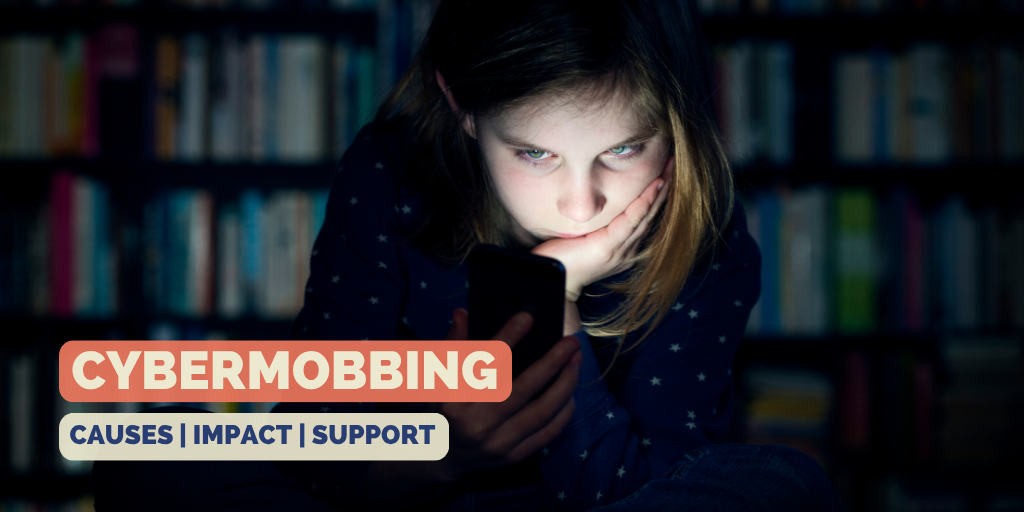
Take a stand against cybermobbing and for respect in the digital space
Cybermobbing is a form of psychological violence that takes place in the digital space and can basically affect anyone who is active online. Young people are particularly susceptible to cybermobbing as they spend a lot of time online, but adults and older people can also be affected by digital hostility.
In our special topic article, you can find out exactly what cybermobbing is, how it differs from classic bullying, what forms it can take and what you can do if you are affected yourself or want to support others.
Find your commitment directly via vostel.de
You have enough information and are ready to get started right away? Then find your suitable commitment for more social cohesion on vostel.de and support non-profit organizations in their important work.
Your team at vostel.de
wishes you every success with your commitment to more cohesion!






No Comments yet!