
Volunteering with disabled people: What you can expect
Many disabled people experience barriers in everyday life that make it difficult or impossible for them to participate in society. Volunteering can have a big impact here, as it creates opportunities for interaction, provides support with everyday tasks and makes it possible for people to take advantage of leisure activities. Volunteering with disabled people is about overcoming barriers and enabling participation.
In this article, we will give you an insight into the challenges and realities of life for disabled people, show you what non-profit organizations do and how you can get involved yourself.
Contents:
- The situation of disabled people in Germany
- How organizations & volunteers support people with disabilities
- What you should look out for when volunteering with disabled people
- Find your volunteer position with disabled people at vostel.de
- FAQ – Frequently asked questions about volunteering with disabled people
1..The situation of disabled people in Germany
Definition: What does disability mean?
According to the Disability Equality Act §3 (Behindertengleichstellungsgesetztes §3) “People with disabilities […] people who have long-term physical, mental, intellectual or sensory impairments which, in interaction with attitudinal and environmental barriers, may prevent them from participating in society on an equal basis with others. Long-term is defined as a period that is highly likely to last longer than six months.”
The definition clearly shows that disability is always an interplay between individual impairments and environmental conditions. If you would like to find out more about the history of the term, we recommend the article by the Federal Agency for Civic Education.
How are disabilities categorized?
Basically, disabilities can be divided into different degrees of severity (GdB = degree of disability). The GdB is measured on a scale from 10 to 100 in steps of ten, depending on the extent of the impairment.
- A GdB of between 10 and 40 can be caused by mild allergies, mild mental disorders, obesity (overweight) or migraines, among other things.
- Starting at a GdB of 50, a person is considered severely disabled, for example due to a mental disability, severe mental disorders, severe visual impairment or severe spinal cord damage.
The EnableMe page of the MyHandicap Foundation provides a comprehensive overview of various disabilities and GdBs. In this article, we will focus on severe disabilities (GdB over 50), as these are best recorded statistically.
How many disabled people are there in Germany?
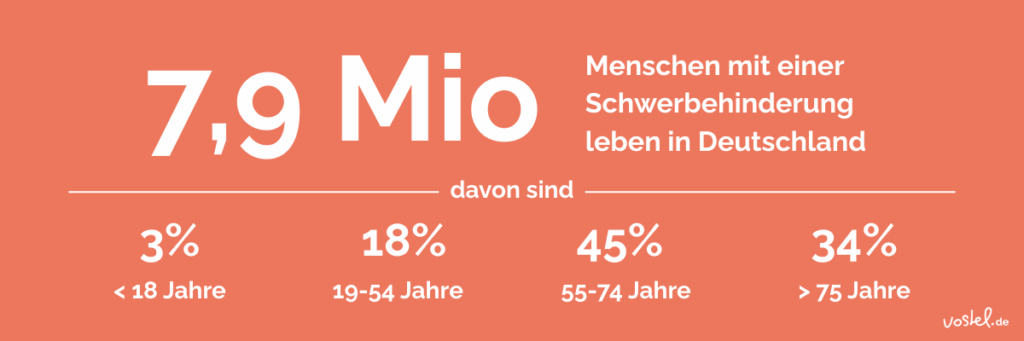
Around 7.9 million people in Germany live with a recognized severe disability. Disabilities rarely develop from birth or during childhood, but often develop later in life, usually as a result of illness (in 91% of cases) or accidents. According to the Federal Statistical Office (statistisches Bundesamt), at the end of 2023, there were around:
- 3% under the age of 18,
- 18% between 19 and 54 years
- 45% between 55 and 74 years,
- 34% older than 75 years.
What forms of disability are there?
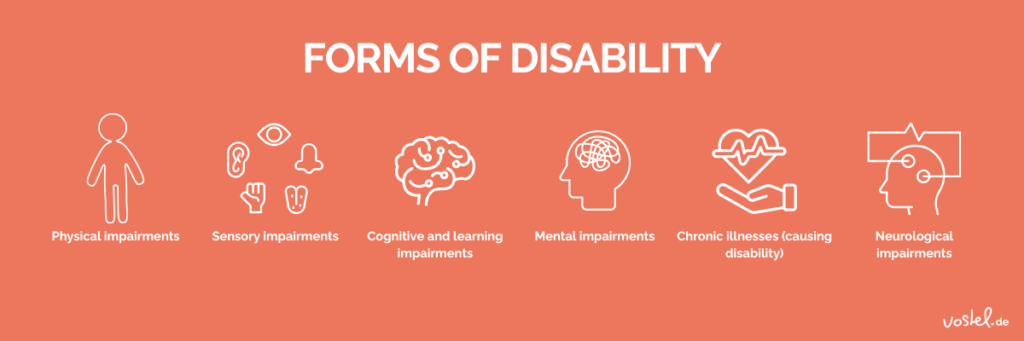
Disabilities can be of very different types, we have created a rough summary here. You can also find a more detailed overview on the EnableMe page of the MyHandicap Foundation
Physical impairments
These include limitations of the musculoskeletal system, strength or mobility, for example due to spinal disorders, amputations, paralysis or chronic pain. At 58%, they are the most common form of severe disability.
Sensory impairments
These include visual impairments, blindness, hearing impairments or deafness. They mainly affect orientation, communication and perception and often make it difficult to use information and digital services.
Cognitive and learning impairments
This form affects people whose cognitive abilities or learning processes are impaired, for example due to genetic factors or early childhood development. They often require more support when it comes to information and everyday decisions.
Mental impairments
These include long-term mental illnesses such as depression, anxiety disorders, schizophrenia or personality disorders. They usually affect social interaction, resilience and orientation in everyday life.
Chronic illnesses (causing disability)
These include diabetes, rheumatic diseases, cardiovascular diseases, ME/CFS, fatigue syndrome, multiple sclerosis and diseases of the internal organs. They are strongly represented in the statistics on severe disabilities, but are often not perceived as a “form of disability”, although the impact on everyday life can be considerable.
Neurological impairments
These include damage to the central or peripheral nervous system, for example due to strokes, epilepsy, Parkinson’s disease or cerebral disorders. They can affect movement, perception, speech or cognitive functions.
Many people live with several impairments at the same time, for example a combination of physical and sensory impairments. Such cases are difficult to categorize in the statistics, but are very common in everyday life.
What barriers restrict everyday life?
Often, it is not the physical, mental or sensory impairment itself that is the biggest obstacle, but the way in which our environment is designed. For this reason, much greater focus is now being placed on barriers and the view that people are not disabled, but rather are being disabled. (more on this in MyAbility’s article on the linguistic use of the term disability).
We at vostel.de have decided to use the term ‘disabled people’ in order to focus on this perspective of being disabled.
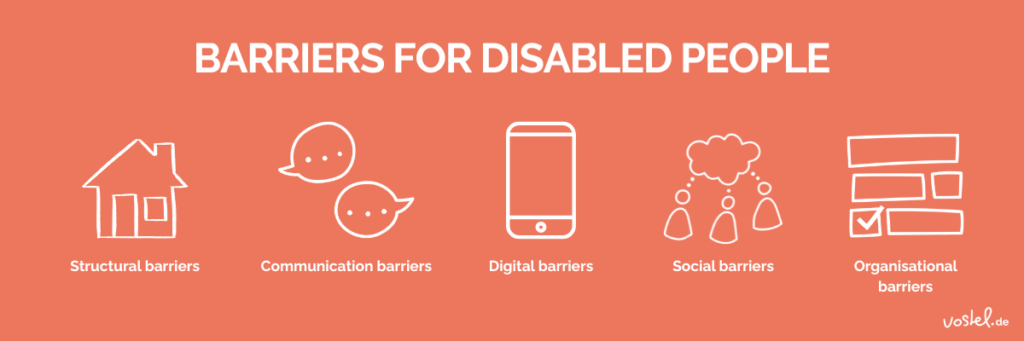
Barriers that make it difficult to participate equally in everyday social life may include:
Structural barriers
These include steps without ramps, a lack of elevators or unclear paths. They mainly affect people with physical or sensory impairments and make access to buildings and rooms more difficult.
Communication barriers
Language that is difficult to understand, small print or a lack of sign language make information inaccessible. People with hearing or learning impairments are particularly affected.
Digital barriers
Inaccessible websites and apps, a lack of subtitles or poor contrast make it difficult to use digital services. This particularly affects blind and visually impaired people as well as people with cognitive impairments.
Social barriers
Insecurities, prejudices or distance in interaction lead to exclusion. This can affect people with any form of disability, especially those with visible impairments.
Organisational barriers
Complicated registrations, unclear procedures or a lack of assistance make it difficult to participate in offers. People who need support with orientation or planning are often affected. This can affect people with any form of disability, especially those with visible impairments.
2. How organizations and volunteers support people with disabilities
What non-profit organizations do
Many organizations create structures that support disabled people and strengthen their self-determination. These include Lebenshilfe, Aktion Mensch, Caritas, Diakonie and numerous local associations and initiatives.
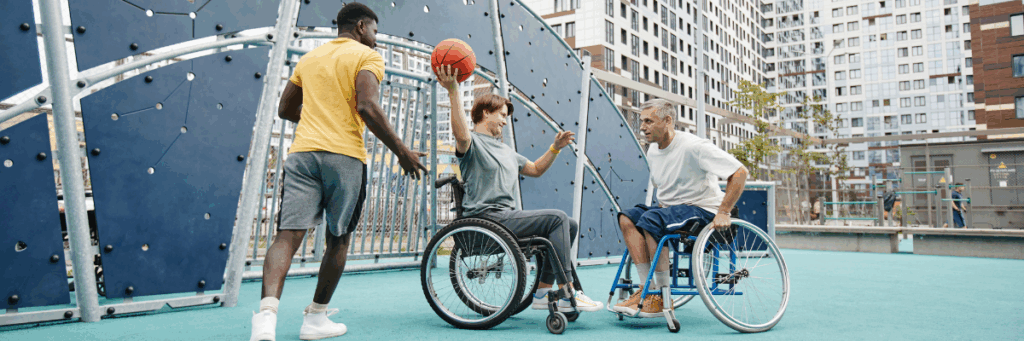
They organize leisure groups, creative workshops, inclusive sports activities or assistance in everyday life. At the same time, they create meeting places where people with and without disabilities can talk to each other and become active together.
How volunteers are involved
Volunteers spend time together with disabled people and provide support with activities that would sometimes be difficult to do alone. This gives the people they support the opportunity to shape their everyday lives in a more self-determined way.
To ensure that volunteers are well prepared, they receive an introduction and information about the person they will be accompanying in advance. Many institutions also offer exchange formats and provide contact persons for questions during the volunteering period. This creates a reliable framework in which encounters can arise and develop.
Typical volunteer activities with disabled people
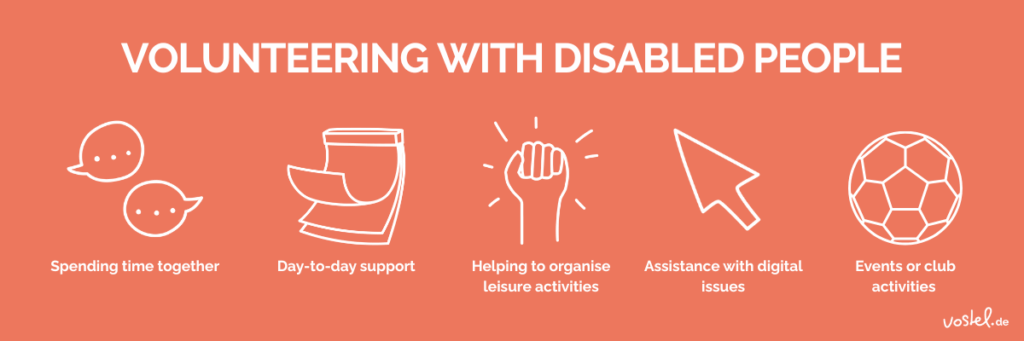
Volunteering can look very different. At vostel.de, you will find many opportunities, for example:
- Spending time together, for example on walks, trips into town, play afternoons or visits to the café together
- Support in everyday life, for example with shopping, visits to the doctor or other trips that are difficult to make alone
- Be part of organising creative or sporting leisure activities by getting involved in crafts, music, baking or inclusive sports activities
- help with digital issues, such as setting up a smartphone, writing messages or operating apps
- Support events or club activities, for example at summer parties, group meetings or inclusive workshops
3. What you should look out for when volunteering with disabled people
There are a number of things you can keep in mind when doing activities together. These include:
Meet on equal terms
Good cooperation is created when you make decisions together and stay in contact. Disabled people usually know very well what they need. If you listen, ask questions and leave room for wishes, the encounter will feel right for both sides.
Use respectful language
Language can create a sense of belonging. Phrases such as people with disabilities put the person at the center and are often perceived as appreciative. At the same time, everyone has their own ideas. If you’re unsure, just ask – a lot will come naturally in a personal exchange.
Finding solutions together
Some challenges only become apparent on the way, for example if a path is not accessible or a situation turns out differently than expected. Then consider together how you would like to proceed. And if you need support, you can contact the organization at any time.
Respect boundaries
Everyone has limits – you as well as the person you are accompanying. Good volunteering happens where both sides feel comfortable and openly communicate what is important to them.
Remain reliable
Clear agreements provide security. Therefore, think about how much time you can contribute at any given time. This can be regular, flexible or one-off support. The organization will help you to find a suitable framework.
Accept support
You don’t have to know everything on your own. If you have questions or are unsure, it helps to talk to the organization early on. They will accompany you, share experiences and give you guidance.
4. Find your volunteer position with disabled people on vostel.de
If you would like to get involved with people with disabilities, you will find many suitable opportunities on vostel.de. These include joint leisure activities, creative or sporting activities, support in everyday life or digital help.
Take a look around the platform, discover projects in your area and find the commitment that suits you.
FAQ – Frequently asked questions about volunteering with disabled people
Do I need previous experience?
No. Many engagements are designed in such a way that you can start without any special knowledge. You usually get an introduction, get to know the person and their needs and can ask questions at any time.
How much time should I schedule for my commitment?
It depends on the project. Some assignments take place regularly, others are flexible or one-off. Most organizations will discuss with you which scope fits in well with your everyday life.
What support will I receive?
You will be trained and usually have a fixed contact person who will help you with any uncertainties. This means you can start your commitment safely and find your way around.
Do I need to be physically fit?
Not necessarily. There are engagements that require some movement, but also many that focus on conversations, joint activities or digital support. You choose what suits you.
What should I do if I am unsure or make a mistake?
Uncertainties are normal. It is important to communicate openly and ask questions. The organization helps you to better understand situations and become more confident.
Discover more articles from our series #VolunteeringExplained
Your vostel.de team wishes you lots of fun with your voluntary work with disabled people!
No Comments yet!