
Volunteering with families: what you can expect
Many families today are under great pressure. A lack of time, financial worries, a lack of networks or stressful life situations often make everyday life challenging. Volunteering can help to relieve parents and support children in their development.
In this article, you will find out what challenges families in Germany face, how organizations and volunteers support them and how you can find a suitable volunteer position with families.
Contents:
1. The situation of families in Germany
Families in Germany today
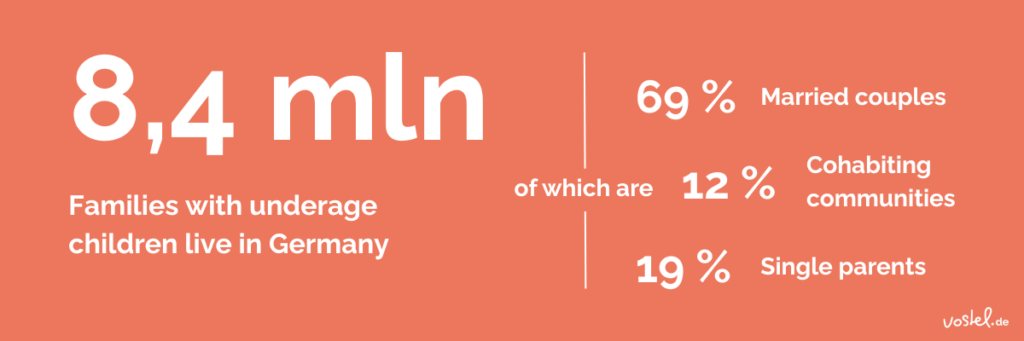
Around 8.4 million families with underage children live in Germany (source: Statistisches Bundesamt, microcensus). Families are diverse. In addition to couple families, there are single parents, patchwork families and families with different cultural backgrounds (sources: Statistisches Bundesamt, BMFSFJ). This diversity of constellations goes hand in hand with very different life realities and challenges.
Overview of families with underage children in Germany:
| Family structure | Share (in percent) | Share (in number of families) |
| Married couples | approx. 69 % | approx. 5.8 million |
| Cohabiting communities | approx. 12 % | approx. 1.0 million |
| Single parents | approx. 19 % | approx. 1.6 million |
Of these, 35% are families with migration history and 65% are families without a migration history.
High stress levels in everyday family life
Many families reach their limits in everyday life, as the Family Monitor of the Bundesfamilienministerium shows. Typical burdens are:
- Time pressure in everyday life, for example due to poor work-life balance, childcare and household chores
- Insufficient or inflexible childcare services, for example a lack of places or limited opening hours at daycare centers and schools
- Financial burdens, for example due to the rising cost of living
- Lack of social networks if there is no support from family or neighbors
- Mental stress and exhaustion when there is a lack of relief and recovery time
These factors mean that many families are dependent on everyday, low-threshold support.
Migration history potentially as an additional burden
In addition, families with migration or refugee experience often find these burdens even greater. A lack of social networks, language barriers and complex bureaucratic requirements make everyday life even more difficult. Language barriers can also have an impact on children’s everyday school life, for example when parents can only provide limited support with schoolwork or information from school and daycare is difficult to understand.
Financial challenges and the risk of poverty
The financial situation also plays a major role for many families. According to the Statistisches Bundesamt, 15.2% of children and young people in Germany were recently at risk of poverty, which corresponds to around 2.2 million young people. Single parents are particularly affected, as their at-risk-of-poverty rate is significantly higher than the average, as figures from the Statistisches Bundesamt show. Financial worries often have a direct impact on children’s participation, for example in leisure activities, education or social interaction.
2. How organizations & volunteers support families

What non-profit organizations do
Non-profit organizations create important contact points for families. These include, among others Caritas, Diakonie, AWO, the Deutsches Rotes Kreuz, the Paritätische Wohlfahrtsverband as well as many local associations, family centers and initiatives. They offer advice, organize meetings and develop projects to help families in their everyday lives.
Many services are aimed specifically at families facing particular challenges, such as single parents, families with low incomes or families with migration or refugee experience. Organizations coordinate this support, network offers of help and ensure that families have low-threshold access to support.
How volunteers are involved
Volunteers are involved in family projects in such a way that they provide families with additional support in their everyday lives. In many projects, they regularly accompany families or individual children over a longer period of time. This support is usually designed to be close to everyday life and can include conversations, joint activities or a supportive presence in everyday family life. Ongoing contact builds trust and a stable relationship that strengthens families where one-off or formal services are often not enough.
There are also temporary commitments. Volunteers support individual activities, open offers or events for families. These assignments are clearly defined and also allow for short-term involvement. Whether on a regular or one-off basis, both forms help to relieve the burden on families and make offers possible in the first place.
Typical fields of voluntary work with families
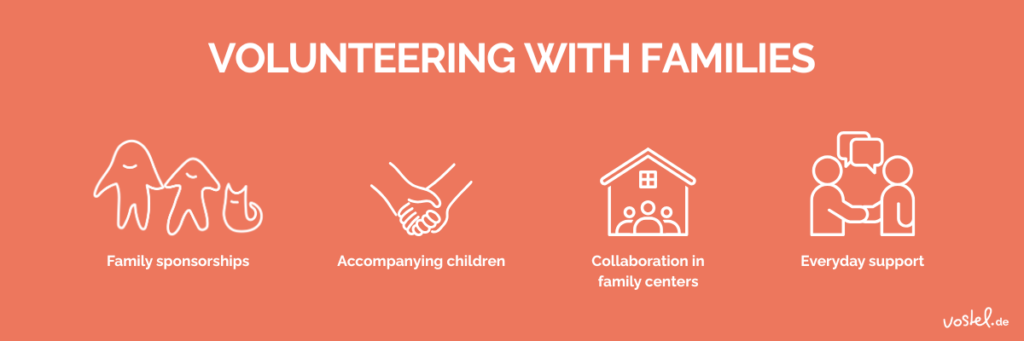
There are a wide range of opportunities and they are geared towards the everyday lives of families. Typical fields of activity are, for example:
- Family sponsorships, in which volunteers regularly accompany a family or individual children over a longer period of time, for example through fixed meetings, discussions, joint leisure activities or support in everyday family life
- Accompanying children, for example through short-term/one-off or regular joint leisure activities, reading aloud and everyday educational support, for example with homework or reading
- Collaboration in family centers or neighborhood projects, for example in open meeting places, parent-child offers or playgroups
- Everyday support, such as accompaniment to appointments or help with organizational tasks
3. What you should look out for when volunteering with families
Reliability and responsibility
Volunteering with families is often personal and long-term. Families build trust and rely on agreements. It is therefore important to be reliable and to keep appointments or promises. Regularity creates security and orientation, especially for children.
Keep your own role and boundaries clear
When volunteering with families, you are a companion, not an educator or counselor. It is important to keep your own role clear and not to take on tasks for which you are not trained. Organizations provide a framework here and offer support in case of uncertainties.
Consciously shaping closeness and distance
Contact with families can quickly become very close, especially when trust is established or stressful issues are shared. A conscious approach to closeness and distance helps to maintain healthy relationships. This also includes respecting private issues or family decisions and not judging them.
Sensitive handling of different family realities
Families live in very different situations and with different values, parenting styles or cultural backgrounds. Openness, respect and a willingness to listen are therefore particularly important. The aim is to strengthen families, not to change them.
Utilise support and exchange
Many organizations offer training courses, permanent contact persons and exchange formats for volunteers. It can be particularly helpful to reflect on experiences and discuss questions when in contact with families. Making use of these offers helps to make volunteering a long-term and pleasant experience for everyone.
4. Find your volunteer position with families on vostel.de
Are you interested in volunteering with families? Then take a look at vostel.de. Here you will find a wide range of opportunities to support families and children in their everyday lives. There is sure to be something suitable for you.
FAQ – Frequently asked questions about volunteering with families
Do I need previous experience to volunteer with families?
In most cases, you don’t need any previous experience. The most important things are reliability, openness and a willingness to accompany families in a respectful manner. The organizations will prepare you for your commitment and will be on hand to answer any questions you may have.
How much time do I need to set aside for volunteering with families?
The time commitment varies greatly. Many voluntary positions are designed in such a way that they can be easily combined with everyday life, studies or work. Often, just a few hours a month are enough to provide tangible support to families.
What specific tasks will I be responsible for?
This depends on the project in question. Typical tasks include, for example, accompanying families or children, providing support with leisure or educational activities or helping with everyday life. You do not provide professional advice, but accompany and support.
Do I work alone or in a team?
In many projects, you are part of a team and have fixed contact persons in the organization. You will also be accompanied on assignments with a lot of direct contact with families and can exchange ideas.
Who is particularly suited to volunteering with families?
Volunteering with families is suitable for people who enjoy being in contact with others, want to take on responsibility and are interested in living together in our society. It is often easy to get started even if you have little time or no previous experience.
Discover more articles from our series #VolunteeringExplained
Your vostel.de team wishes you lots of fun with your voluntary work with families!


No Comments yet!