
Volunteering for equal opportunities: what you can expect
Equal opportunities are a key prerequisite for a fair society. Despite this, educational opportunities, career prospects and social participation in Germany still depend heavily on where someone comes from, how much money their family has or whether a person experiences discrimination. These inequalities have a long-term impact on society as a whole.
We give you an overview of the situation in Germany, show you how you can actively campaign for more equal opportunities and what you should look out for.
Contents:
- Equal opportunities in Germany
- How organizations and volunteers promote equal opportunities
- What to look out for when volunteering for more equal opportunities
- Find your volunteer position for more equal opportunities at vostel.de
- FAQ – Frequently asked questions about volunteering for more equal opportunities
1. Equal opportunities in Germany
Equal opportunities means that all people should have the same opportunities to shape their lives in a self-determined way. In reality, however, these opportunities are unequally distributed in Germany. These differences are particularly evident in the areas of education, income and discrimination.
Educational opportunities depend heavily on the parental home
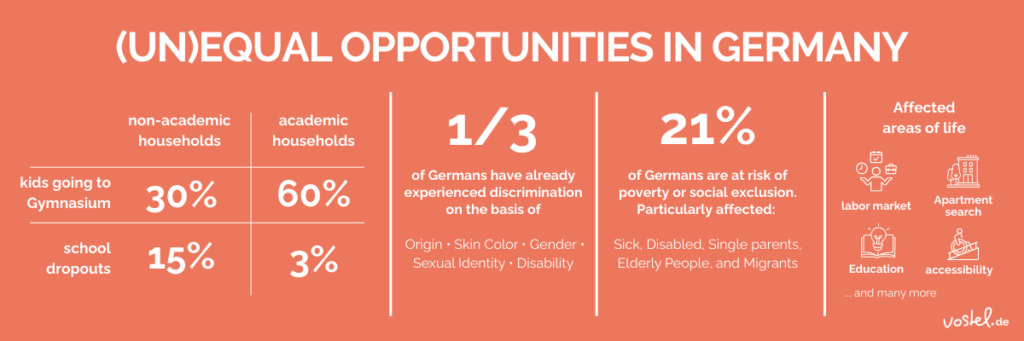
In Germany, social background plays a major role in determining educational pathways. Children from academic households attend grammar school significantly more often than children from non-academic families. While around 60 percent of children from academic households attend a grammar school, this figure is only around 30 percent for children from families without a university degree. (Source: ifo Institut)
Social background influences school-leaving qualifications
The risk of leaving school without a qualification is also unevenly distributed across society. The National Education Report 2024 shows: For young people whose parents have no vocational qualifications, the proportion is around 14 to 15 percent, while it is around 2 to 3 percent for young people from families where the parents have a higher level of education. The parents’ level of education therefore has a considerable influence on their children’s educational opportunities. These early educational disadvantages have a long-term impact on educational opportunities, career prospects and income.
Poverty limits participation
In Germany, around 17.6 million people are at risk of poverty or social exclusion. That is around 21 percent of the population. Those most frequently affected are the sick and elderly, single parents, people with disabilities and people with a history of migration. Financial insecurity not only restricts everyday life, but also access to education, leisure activities and social participation. (Source: Statistisches Bundesamt)
Discrimination is not an isolated case
A significant proportion of the population state that they have already experienced discrimination. Around one in three people report discrimination (Mediendienst Integration), for example on the basis of origin, skin color, gender, disability or sexual identity. These experiences often affect key areas of life such as
- Applications and the job market
- House hunting
- School and training
- Contact with authorities
- Accessibility online and offline
It is particularly problematic that forms of discrimination often overlap. People who belong to several disadvantaged groups are affected particularly frequently and encounter all the more structural barriers.
Why this affects us all
A lack of equal opportunities increases social inequality and weakens social cohesion. If opportunities are permanently unequally distributed, skills for the community are lost and social divisions increase.
At the same time, the topic affects each and every one of us in the long term. As we get older or due to illness, disability or other life changes, we ourselves or people in our immediate environment may become dependent on support. Whether we then have fair access to help, participation and social support depends to a large extent on how equitable our society is as a whole.
2. How organizations and volunteers promote equal opportunities

What non-profit organizations do
In Germany, many civil society organizations are committed to reducing disadvantages and empowering people.
Support for refugees and migrants
Many organizations help people with refugee or migration experience to settle in. Initiatives such as Über den Tellerrand, Start with a Friend or ARRIVALAID facilitate encounters, mentoring and practical support in everyday life.
Large organizations such as Johanniter-Unfall-Hilfe, Diakonie, Malteser Hilfsdienst, Berliner Stadtmission and youngcaritas also offer programs in the areas of integration, social counseling, language support and inclusion.
Participation of people with disabilities
People with disabilities encounter structural barriers in many areas of life, for example in public spaces, in the education system or on the labor market. Organizations such as Sozialheld*innen, Lebenshilfe, Deutscher Behindertenrat and Aktion Mensch are committed to inclusion, accessibility and equal participation and make discrimination visible.
Educational support
A central starting point for more equal opportunities is education. Organizations such as ArbeiterKind, Schülerpaten and ROCK YOUR LIFE! support children and young people from non-academic or low-income families.
Programs such as JOBLINGE or the ReDI School also support young people, especially those with migration experience, in the transition to training, studies or work.
How volunteers are involved
Depending on the project, volunteers work directly with people or support the organization’s work in the background. Many commitments are flexible and can be easily adapted to suit your own everyday life. Digital volunteering is also often possible. This allows people with different time resources and skills to get involved.
Volunteers usually work closely with full-time teams and receive support or training. The aim is clear and respectful cooperation in which volunteers are meaningfully involved.
Typical fields of voluntary work for more equal opportunities
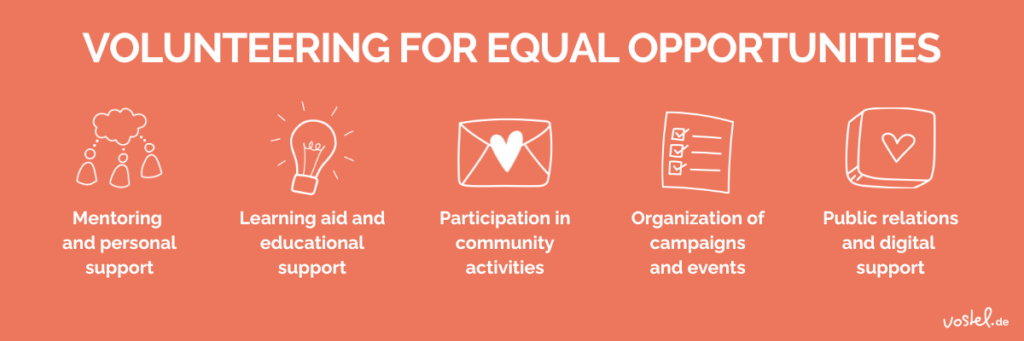
Volunteers can contribute to equal opportunities in a variety of ways, for example:
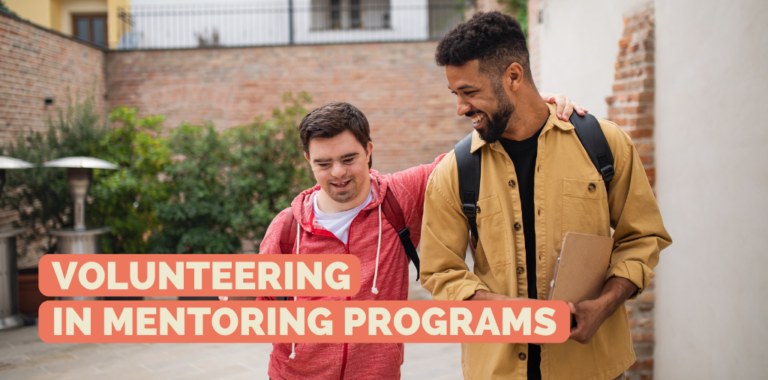
- Mentoring and personal support: You regularly accompany children, young people or adults, talk to them, encourage them and support them with their next steps in school, training or everyday life.
- Learning assistance and educational support: You help with homework, learning German or preparing for exams, individually, in groups or digitally.
- Support with the transition to training or work: you help with applications, CVs or practicing for job interviews and provide information about educational and career paths.
- Accompanying refugees or new immigrants in their everyday lives: You provide support when they arrive, for example when dealing with authorities, finding their way around the district or dealing with everyday issues.
- Helping with meeting and community events: You help with open meeting places, cooking evenings or leisure activities and contribute to exchanges and encounters.
- Support with workshops and educational formats: You support the preparation or implementation of workshops, school projects or educational presentations on diversity and equal opportunities.
- Public relations and digital support: You help with social media, texts, translations or research, often flexibly and regardless of location.
- Organization and coordination of campaigns and events: You support the planning and implementation of campaign days, events or information stands.
3. What to look out for when volunteering for equal opportunities
Bring openness and willingness to learn
In your commitment to equal opportunities, you will encounter realities of life that may differ from your own. It is important to remain open, listen and be prepared to question your own perspective. Specialist knowledge is less important than openness and a willingness to learn.
Assess your own role realistically
Even if volunteers can achieve a lot, they cannot solve structural problems on their own. Your commitment is one contribution among many. It’s not about “saving” people, but about supporting and empowering them. At eye level and with respect.
Dealing sensitively with discrimination
Discrimination is part of everyday life for many people. If you are involved in this area, you may encounter experiences of exclusion. It is important to take this seriously, not to relativize it and not to push those affected into explanatory roles.
Know and accept boundaries
You can and should set limits. This applies to your time commitment as well as emotional stress. Reputable organizations support volunteers, offer opportunities for exchange and clear contact persons. Take advantage of these offers.
Choose the right commitment
Equal opportunities is a broad field. Think about what suits you:
- Would you like to work directly with people or provide support in the background?
- What kind of work do you find exciting?
- How much time can you realistically put in?
- Would you like to be active on site or digitally?
Volunteering is a good fit if it can be realistically integrated into your everyday life.
4. Find your volunteer position for equal opportunities on vostel.de
If you are interested in volunteering in the field of equal opportunities, vostel.de/en can help you find a suitable opportunity. From one-off activities and workshops to regular assignments in mentoring programs, educational projects or anti-discrimination initiatives, you will find a wide range of volunteering opportunities here.
FAQ – Frequently asked questions about volunteering for equal opportunities
Do I need previous experience in volunteering for greater equality?
No. Many organizations are happy to welcome committed people with no previous experience. What is important is openness, reliability and a willingness to learn.
How much time should I plan for?
It depends on the commitment. Some volunteering opportunities are one-off or temporary, others are regular. Many offers are flexible and easily compatible with everyday life, work or studies.
What specific tasks will I be responsible for?
This depends on the project in question. Typical tasks include, for example, accompanying families or children, providing support with leisure or educational activities or helping with everyday life. You do not provide professional advice, but accompany and support.
Can I also get involved digitally?
Yes, there are many digital opportunities, for example mentoring, language tandems, public relations, translations or support with research and social media.
Who is suited to volunteering for greater equality?
For everyone who wants to work for a fairer society. Whether young or old, working, in training or retired.
What concrete impact does my commitment to greater equality have?
You support individuals, strengthen participation and help to reduce inequalities. Even a limited commitment can make a tangible difference for others.
Discover more articles from our series #VolunteeringExplained
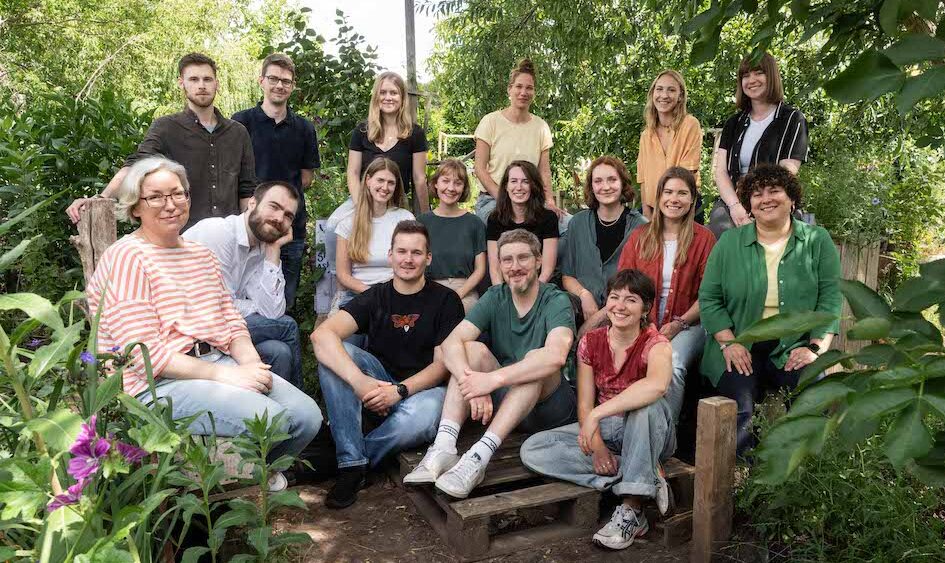
Your vostel.de team wishes you lots of fun with your voluntary work for more equal opportunities!

No Comments yet!