
Volunteering to fight poverty: what you can expect
Poverty in Germany affects more people than one might think. Over 13 million people in this country are considered to be at risk of poverty, and almost a fifth of the population is vulnerable to poverty or social exclusion. This can be seen in everyday life: when there is not enough money for a hot meal, the home is lost or children dont’t have access to good education.
In this article, we will give you an overview of poverty in Germany, show you which organizations are working to combat it and how you can support those affected by volunteering.
Contents:
- The situation of people affected by poverty in Germany
- How organizations & volunteers are active in the fight against poverty
- What you should look out for when volunteering in the fight against poverty
- Find your volunteer position in the fight against poverty on vostel.de
- FAQ: Frequently asked questions about volunteering in the fight against poverty
1. The situation of people affected by poverty in Germany
What does poverty mean in Germany?
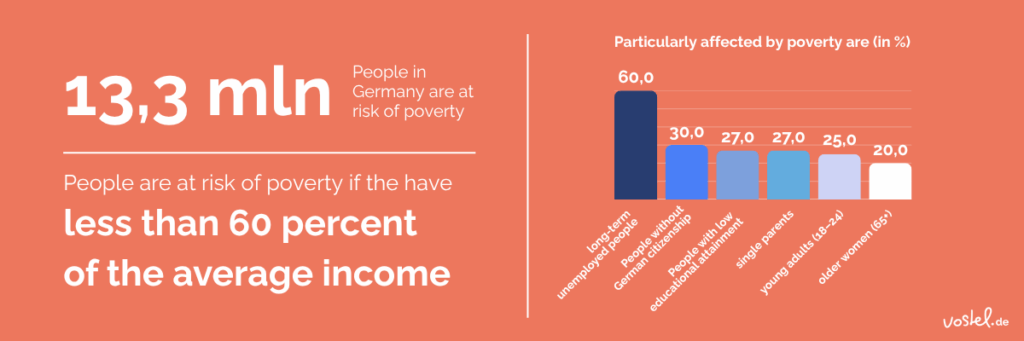
In Germany, poverty is usually measured as relative poverty: Anyone with less than 60 percent of the median income of the overall population is considered at risk of poverty according to the EU definition. 2025, this threshold in Germany was 1,446 Euros net per month for a single person (2024: 1,381 Euros) (Federal Statistical Office).
In everyday life, this means: tight budgets when shopping, hardly any leeway for unexpected expenses and often limited participation in social life. You can find a more detailed overview of what poverty means and how it is measured in our article Poverty in Germany: figures, background information and opportunities to get involved.
How many people are affected?
According to a press release issued by the Federal Statistical Office in February 2026, around 13.3 million people in Germany were recently considered to be at risk of poverty, which corresponds to 16.1% of the population. If people affected by material deprivation or very low labor force participation are also included, the figure rises to 17.6 million, i.e. a good fifth of the population.
And although gross domestic product per capita rose significantly between 2005 and 2024, the poverty rate remained at a consistently high level according to the Paritätische Poverty Report 2025. So economic growth alone will not solve the problem.
Who is particularly affected?
Poverty does not affect everyone equally. According to the Federal Statistical Office and the Paritätische Poverty Report 2025, these people are particularly at risk:
- Single parents: 27 percent of them live below the at-risk-of-poverty threshold.
- Young adults: Around a quarter of 18 to 25-year-olds are considered to be at risk of poverty, including many students and trainees.
- Older women: One in five women aged 65 and over is at risk of poverty. The reason: women are more likely to work part-time, earn less on average and therefore have lower pension entitlements.
- People without German citizenship: at 30 percent, their risk of poverty is around 2.5 times higher than that of German citizens at around 13 percent.
- People with a low level of education: around 27 percent of them are at risk of poverty.
- The long-term unemployed: With an at-risk-of-poverty rate of over 60 percent, they are particularly hard hit.
What are the causes?
The causes of poverty are complex and often interrelated. Low wages and precarious employment ensure that work alone does not protect against poverty. Rising rents and a lack of affordable housing are a particular burden for people on low incomes.
Added to this is the loss of purchasing power due to inflation in recent years, which has hit people living in poverty particularly hard. And as a general rule, people who grow up in poverty often have poorer educational opportunities, which increases the risk of remaining poor in adulthood.
For people with a history of migration, additional factors exacerbate the situation: language barriers, the limited recognition of foreign qualifications and discrimination on the job and housing market make economic entry considerably more difficult.
This is precisely where charitable organizations and volunteers come in.
2. How organizations & volunteers are active in the fight against poverty
What non-profit organizations do
Direct support for people affected by poverty
In Germany, there is a broad network of organizations that support people affected by poverty in very different areas. The best-known contribution is probably made by the Tafel (food banks): the 975 Tafel locations across Germany collect and distribute surplus but perfectly good food to around 1.5 million people in need.
Large charities such as Caritas, Diakonie, DRK, AWO, Johanniter and Malteser also run emergency shelters, clothing stores, soup kitchens and counseling services and are therefore often the first point of contact for people in acute need.
Organizations such as Oxfam or the German Clothing Foundation provide people with clothing and everyday goods at low prices via second-hand and charity stores.
Poverty prevention: long-term approaches against poverty
In addition to direct support, many organizations also focus on long-term approaches. JOBLINGE supports disadvantaged young people on their way into training and employment. Organizations such as StudyTutors and Die Arche Kinderstiftung support children and young people from low-income families by providing free tutoring and leisure activities. And initiatives such as Aktion gegen den Hunger and the Berlin City Mission focus on education and awareness-raising.
You can find out more about the individual areas in our articles Volunteering in food rescue, Volunteering with homeless people and Equal opportunities.
How volunteers are involved
Without volunteers, much of this work could not be done. Over 77,000 people are involved at the Tafel food banks alone, 94 percent of them on a voluntary basis. They sort food, drive tours, stand at the counter and give time and attention to the people who come.
Typical fields of activity in the area of volunteering for democracy and human rights
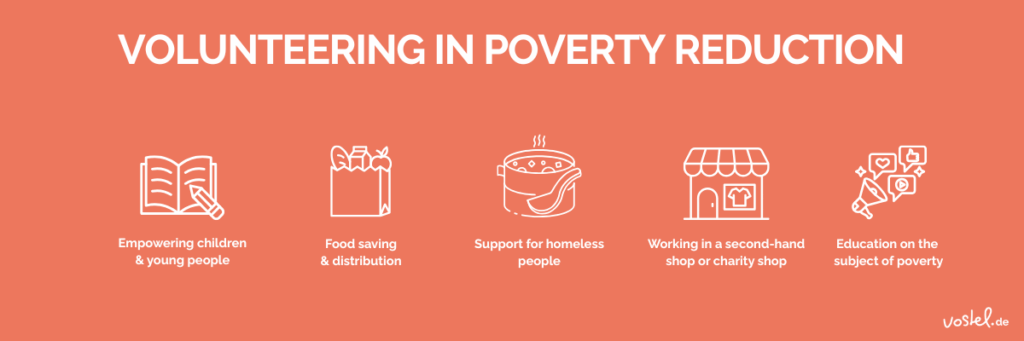
The range of tasks is wide. At vostel.de you will find the following activities, among others:
- Supporting children and young people from low-income families: Giving extra tuition, helping with homework or supporting disadvantaged young people entering training and employment
- Sorting and distributing food: Collect surplus food from retailers, sort it and hand it out to people living in poverty, for example at a food bank in your town or city
- Caring for people without shelter: helping with food and material expenses, providing support in emergency shelters or daycare centers or becoming active in cold weather relief in winter
- Work in a second-hand store or social department store: Sort and refurbish donated clothing and everyday goods and pass them on to those in need
- Enable hygiene and basic care: Supporting and supervising shower and washing facilities for people without a fixed abode, for example with the GoBanyo shower bus
- Accompanying and advising people affected by poverty: Being there as a discussion partner for people in social emergencies or supporting them with visits to the authorities
- Educate people about poverty: Co-organize workshops or guided tours on the topic of poverty and homelessness, for example at the Berlin City Mission
3. What you should look out for when volunteering in the fight against poverty
Encounter poverty without prejudice
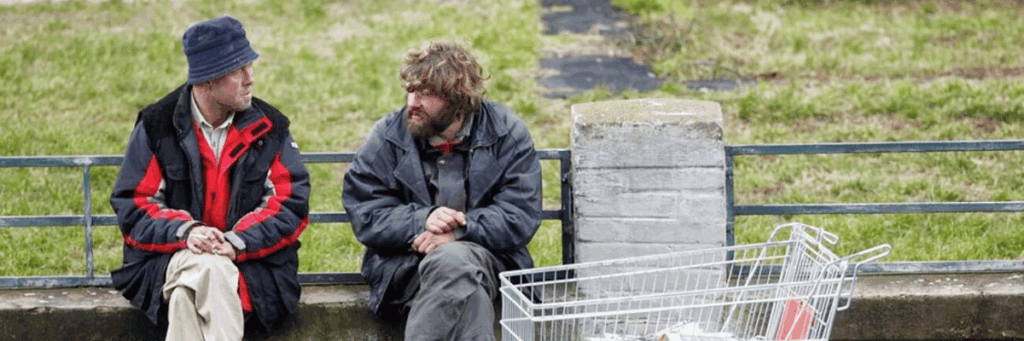
Poverty has many faces and many causes. Anyone who gets involved will encounter people in very different life situations: Single parents who can barely make ends meet despite working, older people with insufficient pensions or young people who have grown up without a family network. Clichés such as “it’s their own fault” or “they should have tried harder” do not do justice to reality. An open, unprejudiced attitude is the most important basis for any commitment in this area.
Be sensitive to feelings of shame
Many people living in poverty feel ashamed of their situation. This influences how they deal with offers of support, whether they ask for help or prefer to stay away. A discreet, respectful attitude is therefore particularly important: it is about meeting people at eye level, not about helping and waiting for gratitude.
Know the difference between soothing and solving
Volunteers do valuable work in the fight against poverty. However, they primarily alleviate the immediate consequences of poverty without eliminating its structural causes. This is not a weakness of commitment, but an important classification. Those who understand this from the outset can realistically assess their contribution and remain motivated in the long term.
Deal with complex living situations
People affected by poverty often carry several burdens at the same time: debt, mental illness, addiction, homelessness. This can be challenging for volunteers. Many organizations therefore offer introductions, contact persons and occasional exchange sessions. Making use of these offers is not a sign of weakness, but helps to make the commitment sustainable.
Choose a suitable activity in the fight against poverty
From sorting groceries to tutoring, the spectrum is wide. It is worth considering in advance which task suits your strengths and available time. Some activities require regular commitment, others are possible on a one-off or project basis. Many organizations also offer introductory or trial assignments so that you can take your time to find out what suits you best.
4. Find your volunteer position in the fight against poverty on vostel.de
Would you like to get involved in the fight against poverty and don’t know where to start? On vostel.de you will find numerous opportunities to get involved in this area: from handing out food at a food bank to working in a second-hand store to tutoring children from low-income families. Whether one-off, project-based or regular, on-site or location-independent: Find the right commitment for you now.
5 FAQ: Frequently asked questions about volunteering in the fight against poverty
What specific actions can I take to help tackle poverty?
There are many opportunities: you can sort and hand out food at a food bank, work in a second-hand store or clothing store, help children from low-income families with their homework or accompany people affected by poverty on visits to the authorities. On vostel.de you can find suitable offers in your area or wherever you are.
Do I need any specific prior knowledge or qualifications?
No special qualifications are required for most activities in the fight against poverty. What is more important is reliability, openness and a willingness to lend a hand. New volunteers are usually given an induction by the organization so that you are well prepared for your first assignment.
How much time should I schedule?
This depends on the type of commitment. Some activities, such as a one-off commitment at a food bank, only require a few hours. Others, such as regular tutoring or a visiting service, are designed for continuous commitment. Many organizations also offer trial assignments so that you can take your time to find out what suits you best.
Is volunteering in the fight against poverty emotionally challenging?
That can be the case. People affected by poverty often carry several burdens at the same time, and there are not always quick solutions. At the same time, many volunteers report that, despite or precisely because of these challenges, their commitment is experienced as very meaningful and enriching. Most organizations offer contact persons and occasional exchange sessions that help to put difficult experiences into perspective.
How do I find a suitable offer in my town?
On vostel.de, you can search specifically for volunteering opportunities in the fight against poverty in your city or region. You can filter by regularity, target group and field of activity to find the offer that suits you best.
What is the difference between poverty and homelessness?
Poverty and homelessness are often linked, but they are not the same thing. Poverty refers to a financial situation in which people have significantly less income than the social average. Homelessness is a possible consequence of poverty, but does not necessarily occur. Many people living in poverty have a home but can hardly afford anything else. You can find out more about this in our article Volunteering with homeless people.
Discover more articles from our series #VolunteeringExplained
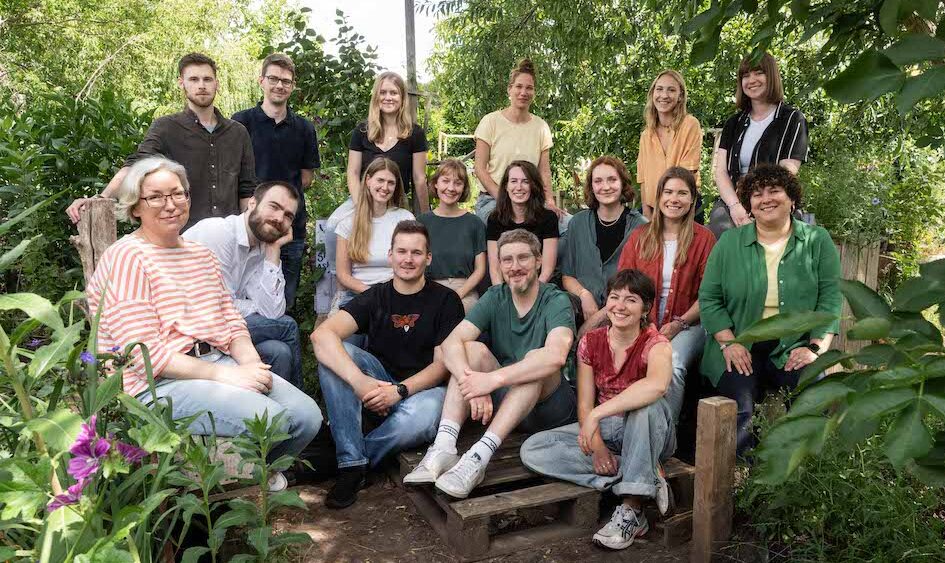
Your vostel.de team wishes you valuable experience in your voluntary work in the fight against poverty!


No Comments yet!