
Volunteering in Hospice Care: What to Expect
Every year, more than 850,000 people die in Germany. Most of them wish to spend the final stage of their lives at home and in familiar surroundings. The reality, however, is quite different, as the majority die in hospitals or nursing homes, many of them alone. This is precisely where volunteer work in hospice care comes in.
Volunteer hospice caregivers give seriously ill and dying people, as well as their loved ones, the time, attention and listening ear that are often lacking in the stressful daily routine of hospitals and nursing homes. In this article, we’ll show you the current state of end-of-life care in Germany, which organizations provide support in this area, and what you should keep in mind as a volunteer if you’d like to get involved in this special field.
Contents:
- The Situation of the Dying and Their Loved Ones in Germany
- How to Support Organizations and Volunteers in Hospice Care
- What to Keep in Mind When Volunteering in Hospice Care
- Find a volunteer position in hospice care at vostel.de
- FAQ – Frequently Asked Questions About Volunteering in Hospice Care
1. The Situation of the Dying and Their Families in Germany
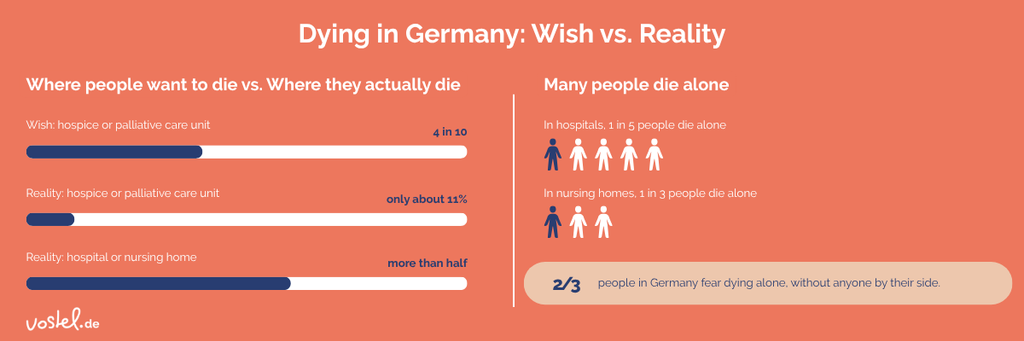
Each year in Germany, slightly more than one percent of the population dies, which amounts to several hundred thousand people. Surveys consistently reveal a clear gap between desire and reality: About four in ten people would like to die in a hospice or end-of-life care facility. In reality, however, well over half of people spend their final days in a hospital or nursing home.
Only a small proportion die in a specialized hospice facility (about 4.8 percent) or in a palliative care unit (about 6.2 percent). It is particularly distressing that many people die alone. In hospitals, this applies to about one in five people; in nursing homes, it is as high as one in three. There is also a great deal of fear surrounding this issue: About two-thirds of people worry that they will be left alone when they die.
2. What Organizations and Volunteers Do in Hospice Care

What Hospice Services Provide
In Germany, there are two forms of hospice care: outpatient and inpatient. Outpatient hospice services support people where they live, that is, at home, in nursing homes or in hospital wards. Inpatient hospices are standalone facilities with a family-like atmosphere where terminally ill people spend the final phase of their lives, on average about 22 days.
These services are provided by major charitable organizations such as Caritas, Diakonie, the German Red Cross (DRK), AWO, the Johanniter, and the Malteser, as well as by numerous smaller, often entirely volunteer-run local hospice associations. The German Hospice and Palliative Care Association (DHPV) serves as the national advocacy group for the hospice movement and connects the many individual organizations.
Where did the hospice movement come from?
The hospice movement in Germany emerged in the 1980s out of volunteer efforts with the goal of providing psychosocial, spiritual, and in some cases medical support to people who are dying. Much has changed since then. The number of outpatient hospice and palliative care services has more than tripled since 1996. Today, in Germany there are:
- about 1,500 outpatient hospice services
- Approximately 270 inpatient hospices for adults and 21 for children, adolescents, and young adults
- Approximately 330 palliative care units in hospitals, four of which are specifically for children and adolescents
Despite these improvements, there remains a wide gap between what we hope for and reality. That is precisely why we continue to need dedicated people who will stand by the dying people and their loved ones.
How volunteers are involved
Hospice care would not be possible without volunteer work. More than 100,000 people in Germany are actively involved in this way. A large portion of outpatient hospice services are even run entirely by volunteers, without funding from health insurance companies.
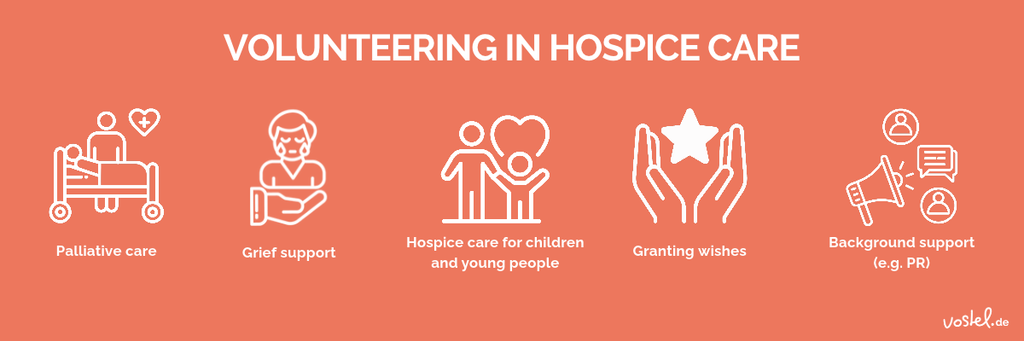
Before volunteers begin accompanying the dying, they undergo structured training. Afterward, they take on a wide variety of tasks, depending on what suits them best. Typical areas of responsibility in volunteer hospice work include:
- End-of-life care: Giving your time, listening, and being there, whether at home, in a nursing home, in a hospital, or at an inpatient hospice
- Grief Counseling: Continuing to support family members even after a person has died, for example, through grief support groups
- Pediatric and Adolescent Hospice Care: Providing support to children and adolescents with life-limiting illnesses, as well as their siblings
- Making Wishes Come True: Supporting “Wünschewagen” projects that enable seriously ill people to take one last special trip
- Behind-the-scenes support: If you prefer not to have direct contact with dying people, you can get involved in fundraising, event planning, or public relations
As varied as the tasks may be, the common goal is always to restore a sense of dignity, security, and humanity to the seriously ill and dying, as well as to their loved ones.
3. What to Look for when volunteering in hospice care

Preparation is mandatory
Unlike many other volunteer positions, structured training is mandatory here. For outpatient end-of-life care, the training typically ranges from 80 to 120 hours; for inpatient care, it’s usually around 60 hours. The courses aren’t just about practical knowledge—such as communication, setting boundaries, or legal basics like advance directives. Above all, they focus on your own inner attitude. You don’t need any medical or nursing training for this. The focus is on simply being there, not on providing care.
Are you the right fit?
Above all, this volunteer role requires a stable personal situation. Anyone who is currently going through a serious life crisis or is grieving should wait before getting involved. Instead, the following are important:
- Openness and a non-judgmental attitude toward the topics of illness, dying, and death
- the ability to set boundaries and not bring work-related stress home
- Reliability, as a relationship of trust develops over time
- Flexibility in terms of time, since many support arrangements are open-ended
Dealing with Your Own Stress
Dealing with dying and death can be emotionally taxing. That is why hospice services typically provide dedicated coordinators to serve as points of contact, as well as regular support or supervision groups. These resources help individuals process their experiences and find their own balance between closeness and distance.
If you realize that a mentoring situation is demanding more than you can give, it’s important to reach out to the leaders in your organization. They will help you find a suitable solution.
4. Find a volunteer opportunity in hospice care on vostel.de
Would you like to offer time, companionship, and a listening ear to the dying and their families? Or would you prefer to contribute behind the scenes, without direct contact with the dying? At vostel.de, you’ll find numerous opportunities to volunteer in hospice care throughout Germany and with various organizations.
5. FAQ – Frequently Asked Questions About Volunteering for Sponsorship and Mentoring Programs
What exactly does a volunteer hospice caregiver do?
The focus is on being there for seriously ill and dying people, as well as their loved ones. This can involve listening, sharing a moment of silence, reading aloud, or simply spending time together. Those who prefer not to have direct contact can also help with organizational tasks.
Do you need medical or nursing training for this?
No. Volunteers do not perform nursing or medical tasks; those are the responsibility of full-time professionals. What matters more are empathy, openness, and a willingness to connect with people going through a particularly sensitive phase in their lives.
How does the preparation process work, and how long does it take?
Before starting your assignment, you’ll complete a mandatory preparatory course. Depending on the provider and the type of assignment, the course typically ranges from 60 hours (inpatient) to 120 hours (outpatient). Topics include communication, setting boundaries, and legal fundamentals.
How much time do I need to commit?
After completing their training, most volunteers commit to two to four hours per week. The exact number of hours will be determined on an individual basis in consultation with your coordinating office.
Am I suited for this, even though I’m a little hesitant when it comes to the topic of death?
A certain degree of openness toward illness, dying, and death is important, but it doesn’t have to be fully present from the very beginning. That’s exactly what the preparatory courses are for. Above all, it’s important that you aren’t currently going through an acute life crisis or dealing with recent grief.
What is the difference between outpatient and inpatient hospice care?
Outpatient hospice services provide care to people where they live—such as at home, in a nursing home, or in a hospital. Inpatient hospices are standalone facilities where people spend the final stage of their lives.
Can I get involved even without having direct contact with people who are dying?
Yes. In addition to providing direct support, there are many other ways to get involved, such as through public relations, fundraising, or organizing events.
What happens if being a support person becomes too emotionally taxing for me?
Hospice services typically provide designated points of contact as well as regular support or supervision groups. This allows you to process what you’ve been through and ensures you don’t have to face stressful experiences alone.
What is pediatric hospice care?
Pediatric hospice care is specifically designed for children and adolescents with life-limiting illnesses, as well as their siblings and families. The support and preparation provided are tailored to this particular group.
Does the preparation cost anything, or is it reimbursed?
This varies from organization to organization. Some hospice services charge a course fee, which is refunded after a certain amount of time spent volunteering. It’s best to check directly with the organization of your choice.
Discover more articles from our #VolunteeringExplained series

The vostel.de team wishes you a rewarding experience volunteering in hospice care!



No Comments yet!