

Volunteering for Students: How to Balance Your Studies and Community Service
Between lectures, exams, and part-time jobs, students often have little time left for volunteer work. Yet young people in higher education are particularly open to civic engagement and to both social and personal growth. The reason many still don’t follow through is rarely a lack of interest, but rather the question of how to realistically organize volunteer work alongside their studies.
In this post, we’ll show you the current state of student volunteerism in Germany, what opportunities are available both on and off campus, and what you should keep in mind to ensure that your volunteer work fits well with your studies.
Contents:
- Student Volunteer Work in Germany
- Where and how students can volunteer
- What You Should Keep in Mind as a Student When Volunteering
- Find a volunteer position to do while you’re in school on vostel.de
- FAQ – Frequently Asked Questions About Volunteer Work for Students
1. Student Volunteer Work in Germany
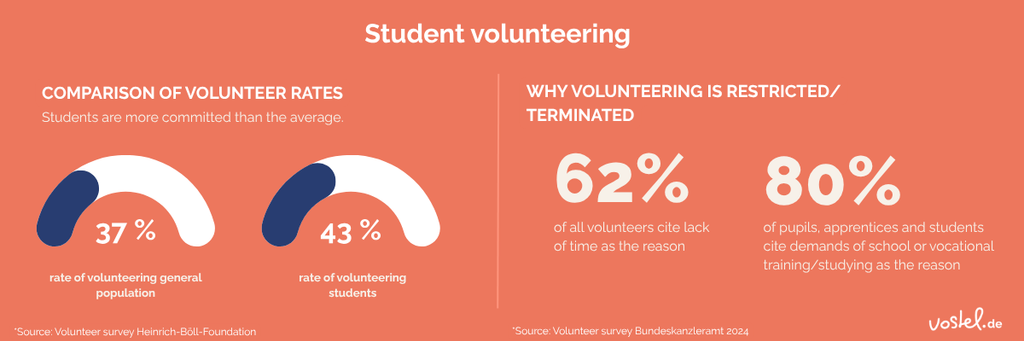
Volunteering has a firm place in German society. According to the latest Volunteer Survey, approximately 36.7% of the population aged 14 and older volunteered in 2024, which corresponds to just under 27 million people. Students have traditionally been a group particularly willing to volunteer. In earlier surveys, their rate—at 43% (vs. 36%)—was significantly higher than the population average.
Volunteer Work & Scholarships
This is also because volunteer work can pay off directly: Numerous scholarship programs, such as the Deutschlandstipendium or the political parties’ foundations, take into account not only grades but also community involvement when awarding scholarships. To find out exactly how volunteering can strengthen your scholarship application, check out our article on Scholarships & Volunteering.
Capacity is often lacking
At the same time, however, it becomes clear why this group often scales back or gives up their volunteer work. For high school students, apprentices, and college students, the demands of school and training—accounting for 80% of responses—are among the most common reasons why they scale back or completely stop their volunteer work. Rigid academic schedules, exam periods, and the frequent need for part-time jobs simply leave many with little time to spare.
Commitment Despite a Busy Schedule
So there is certainly a desire among students to help shape society; the challenge lies more in putting this into practice. That is precisely why we need forms of engagement that can be flexibly incorporated into everyday student life—whether they are time-limited, project-based, or directly integrated into the university. The next chapter illustrates what this might look like in practice.

2. Where and how students can volunteer
Depending on how much time and interest you have, there are a wide variety of ways to get involved. Some options are suitable for a one-time commitment, while others are better suited for regular, long-term involvement.
Involvement directly at the university
Those who are on campus regularly anyway can often find a volunteer opportunity right there that fits easily into their existing daily routine, without having to travel anywhere extra. Many colleges and universities offer a variety of options for this:
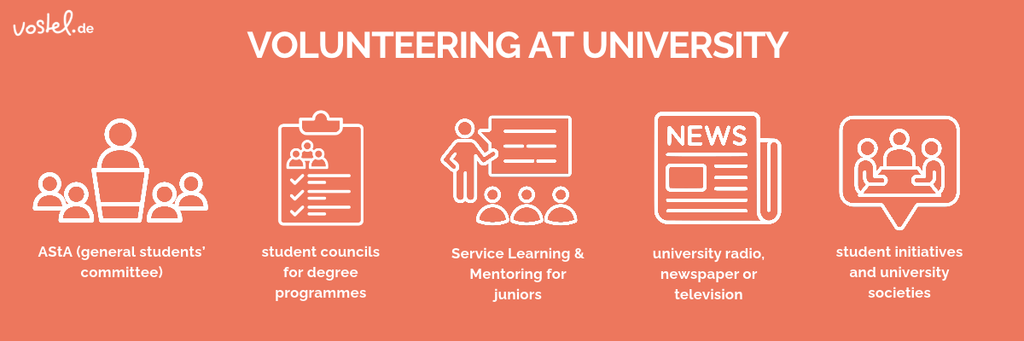
- AStA (General Student Committee): Represents student interests vis-à-vis the university, providing initial social and legal counseling on issues related to academic life as well as university policy
- Student Councils: Organizing orientation events for first-semester students, field trips, and addressing student concerns within their respective fields of study
- College radio, newspaper, or television: hands-on experience for anyone who wants to work in the media or communications field later on
- Student initiatives and college groups: self-organized clubs and communities that advocate for socially relevant and political issues, such as sustainability, equal opportunity, political situations, or international exchange
- Mentoring Programs: Helping New Students Adjust to College Life
Service Learning: Community Engagement Becomes Part of the Academic Experience
Another way to get involved is through service learning, also known as “learning through engagement.” In this program, projects that benefit the common good are planned and carried out directly as part of courses, and in some cases even count toward academic credit. This allows you to combine academic learning directly with social engagement, without having to spend any extra time outside your class schedule. You can learn more about this concept from the “Education Through Responsibility” university network, which promotes and coordinates service learning at German universities.
Volunteering with Nonprofit Organizations
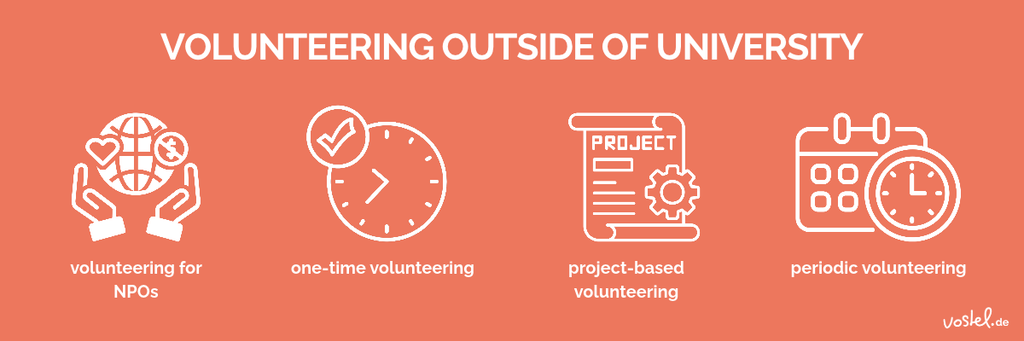
If you’re looking to get involved beyond campus, nonprofit organizations offer a wide range of opportunities, from social organizations like food banks or mentoring programs to environmental and sustainability initiatives, as well as political and cultural engagement, depending on how much time and commitment you can contribute.
One-Time Commitment
Perfect if you just want to get a feel for it or don’t want to commit long-term, for example:
- Helping out with a fundraiser or a charity run
- Helping with a cleanup, such as a trash collection effort along a river or in a park
- A single volunteer assignment at a homeless shelter, a clothing distribution center, or a food bank
Project-Based Involvement
Time-limited, but with a bit more continuity than a one-time assignment, for example:
- Volunteering at a cultural festival or a student conference
- Support for an environmental project, such as a restoration initiative
- Social media or public relations for a limited-time campaign
Regular Volunteer Work
For anyone who would like to take on a regular, recurring task:
- Weekly volunteer work at a food bank or soup kitchen
- Regular tutoring or homework help for children from low-income families
- Volunteering at an animal shelter or an environmental organization
- Involvement in a sports club, for example as a coach
Many students deliberately choose a topic that aligns with their field of study, for example, to apply theoretical knowledge in a practical setting. However, this isn’t a requirement; what really matters in the end is that the work matches your interests.
3. What You Should Keep in Mind as a Student When Volunteering

Plan realistically so your studies don’t suffer
The biggest challenge is usually time management. Before you decide to volunteer, it’s worth taking an honest look at your schedule: How much free time do you really have, even during exam periods? It’s perfectly fine to start small or to choose a short-term project instead of a long-term commitment.
Volunteer Allowance and BAföG
For your volunteer work, you can receive a financial allowance known as the “volunteer allowance.” In 2026, this allowance will be up to 960 euros per year and is exempt from taxes and social security contributions. It’s important to know that this allowance isn’t counted toward your BAföG benefits. So your volunteer work won’t affect your financial aid.
The 20-hour limit on Werkstudi jobs does not apply to volunteer work
If you also work as a student employee, the rule is that you should not work more than 20 hours per week in order to continue to be considered primarily a student. You do not need to include your volunteer work in this calculation, as it does not constitute an employment relationship and therefore does not count toward this limit. If in doubt, however, check with your health insurance provider or university if you are combining a job with volunteer work.
4. Find a volunteer position to do alongside your studies on vostel.de
Now you know what kind of volunteer work fits your schedule and daily life as a student. On vostel.de, you’ll find opportunities that match your needs: Use the time commitment filter to search specifically for volunteer roles that can easily be incorporated even during exam periods, or filter by subject area if you’re looking for something related to your field of study or something deliberately outside of it.
5. FAQ – Frequently Asked Questions About Volunteer Work for Students
As a student, how do I find a suitable volunteer position?
The easiest way to get started is often through your own college or university—for example, through the student council (AStA), student associations, or mentoring programs. If you’d like to look beyond your campus, platforms like vostel.de offer numerous other opportunities filtered by topic, location, and time commitment.
How can I balance volunteering and my studies?
It’s best to start by taking a realistic look at your class schedule, especially with regard to exam periods. Time-limited or project-based commitments are often easier to fit in than long-term, weekly obligations.
How can volunteering benefit my future career?
Volunteering helps you develop skills such as teamwork, organizational skills, and strong communication abilities—all of which are in high demand in the professional world. It also looks good on your resume and shows hiring managers that you take on responsibility and think outside the box. However, your personal motivation for volunteering should be more important than the purely career-related benefits.
What is service learning, and do I earn credit points for it?
Service learning directly links projects that serve the public good to course content. Depending on the university and degree program, credit points may be awarded for this. It’s best to check with your university directly for more information.
Does volunteering affect my BAföG?
No. The volunteer allowance is not counted as income when calculating BAföG.
Can I do volunteer work in addition to my part-time student job?
Yes. The 20-hour limit for working students applies to employment relationships. Volunteer work generally does not count toward this limit, but if in doubt, it’s worth checking with your health insurance provider or university.
What is the volunteer allowance, and does it apply to students as well?
The volunteer allowance is a tax deduction for volunteer work in nonprofit organizations; in 2026, it will amount to up to 960 euros per year. It is generally available to all volunteers, regardless of their student status.
What volunteer opportunities are available on campus?
These include, among others, the AStA, student councils, campus radio and newspapers, as well as mentoring programs for first-semester students and student initiatives.
How does volunteer work look on my resume, even if it means I’ll take longer to finish my degree?
Volunteer work demonstrates commitment, a sense of responsibility, and social skills. Many hiring managers view one or two additional semesters favorably if they were used productively—for example, through volunteer work.
Can I get involved without committing a lot of time or making a long-term commitment?
Yes. Many forms of volunteer work are short-term or project-based, such as for individual events or initiatives. This makes it easy to integrate volunteer work into your daily student life, even if you don’t have much time.
The vostel.de team wishes you a rewarding experience in your volunteer work alongside your studies!






No Comments yet!