

4 positive effects of corporate volunteering for companies
Whether as team building, part of a sustainability strategy or as an employer branding tool, corporate volunteering is becoming increasingly important. Since 2015, we at vostel.de have been supporting companies in setting up effective programs and implementing them with non-profit organizations. In this article, we will show you the positive effects corporate volunteering can have in four key areas.
For a practical insight, we spoke to Theresa Krohn (Head of Corporate Communications & Sustainability at Scout24) and Digney Eisner (CSR Manager at Delivery Hero), who shared their views and goals of their in-house corporate volunteering programs with us.
Overview
1. Create added value for society

Corporate volunteering enables companies to assume responsibility beyond their core business. Through the commitment of their employees, they make a visible contribution to the common good and show that they are part of an active civil society, not just economic players.
Concrete impact on site
Through their support, companies strengthen local organizations, social projects and ecological initiatives. They help to tackle social challenges such as educational inequality, poverty or the climate crisis and make resources available that the non-profit sector would otherwise lack.
“We offer corporate volunteering opportunities for our employees to give something back to the communities in which they live and work. Every Delivery Hero employee can use two days per year to volunteer.“
Digney Eisner from Delivery Hero
Credibility instead of image cultivation
For corporate volunteering to be perceived as a serious commitment, it must be in line with the company’s attitude and actions. If it only takes place on paper or primarily serves the external image, the impression of greenwashing is quickly created.
“Corporate volunteering has a long tradition at Scout24 and is part of our corporate culture. Since 2011, our employees have been able to get involved in various social projects once a year at our Social Day. We are convinced that it is right and important to give something back to society and help shape it in a positive way.“
Theresa Krohn from Scout24
2. Strengthen personnel development

Corporate volunteering offers employees the opportunity to strengthen new skills beyond their day-to-day work and to use existing skills in an unfamiliar context.
Strengthening social skills
Depending on the assignment, whether with senior citizens, children or people with refugee experience, employees are required to adapt their communication and behavior flexibly. This trains important soft skills, including empathetic communication, the ability to deal with conflict, changing perspectives and intercultural competence.
Application and development of specialist know-how
Pro bono engagements allow employees to contribute and develop their professional skills in a targeted manner. This not only strengthens their self-confidence, but also their ability to communicate knowledge in an understandable and solution-oriented way and to apply it in unfamiliar contexts.
“Using existing skills and knowledge to support a charity and developing new skills and expertise in this context are clear benefits of corporate volunteering.”
Digney Eisner from Delivery Hero
3. Increase employee motivation and loyalty

Salaries alone are often no longer enough to retain employees in the long term. Motivation is increasingly generated when work is experienced as meaningful and the company is perceived as a responsible part of society.
Purpose as an important factor
Younger generations in particular attach great importance to a sense of purpose and expect employers to actively contribute to the common good. Corporate volunteering creates a tangible link between the job and social commitment and thus increases emotional loyalty to the company.
Positive effects on loyalty
A study by Deloitte from 2024 shows: Employees who are involved in corporate volunteering also identify more strongly with their company and are more likely to stay with it. This is particularly effective if the commitment is voluntary and credibly embedded in the corporate culture.
4. Promote team development
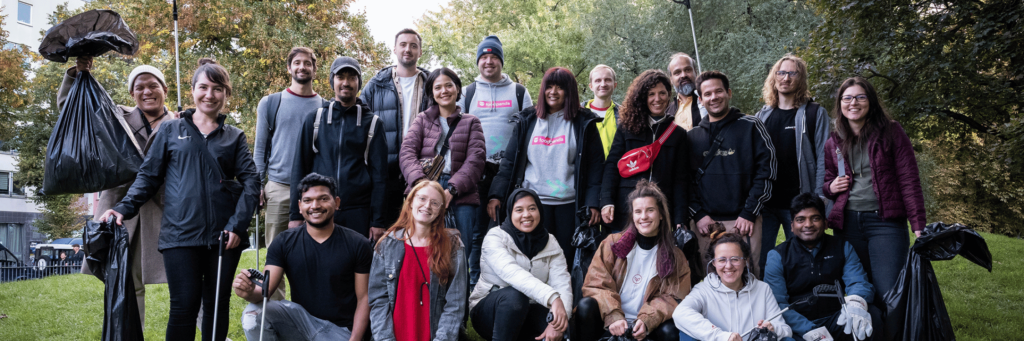
Joint commitment acts like a teamwork boost: employees experience themselves outside their usual roles, work towards a common goal and automatically strengthen their team spirit.
Cooperation at eye level
Corporate volunteering creates situations in which hierarchies take a back seat. Teams have to find spontaneous solutions, coordinate and act flexibly. This trains team spirit, trust and open communication.
Positive shared experience
When the team visibly achieves something together, it not only boosts motivation, but also strengthens the bond between them. Joint positive feedback from organizations or target groups often has a stronger effect than any internal team-building measure.
Corporate culture across teams
Corporate volunteering can also help employees from different departments to come into contact with each other. In addition to the internal team structure, this also strengthens the overarching corporate culture in the long term.
5. Success factors for corporate engagement

For corporate volunteering to be effective, it must be considered as part of the corporate strategy, not as a side project. There are a number of factors that need to be taken into account:
Strategic embedding & clear responsibilities
Corporate volunteering should be part of the corporate strategy. Companies should therefore plan, support and develop the programs with fixed teams and responsibilities.
“Corporate volunteering is managed by our sustainability team. There is also the Cares Team. These employees volunteer for a good cause alongside their work and organize a Christmas campaign for needy children or clothing donations every year, for example.”
Theresa Krohn from Scout24
Orientation towards social needs
A program only has a lasting effect if it is geared towards the actual needs of non-profit organizations, not purely internal ideas or image goals.
Low-threshold internal communication
Employees need to know why the program exists, how it works and how they can participate. Low-threshold information and participation opportunities are crucial.
Voluntariness & recognition
Corporate volunteering must not become an obligation. Engagement remains effective when employees participate voluntarily and their commitment is visibly valued.
Resources & framework conditions
Time, budget, time off and clear processes are necessary to ensure that engagement does not become an additional burden for employees or organizations.
Continuous further development
A program only remains relevant if it is regularly reviewed and adapted. This also means questioning and further developing familiar formats.
6. corporate volunteering with vostel.de
If you would like to find out more about what corporate volunteering could look like in your company, take a look at our website. Or contact us directly and we will be happy to support you with the planning and implementation.
Rebecca and your team from vostel.de






No Comments yet!