
Volunteering in animal welfare: what you can expect
Animal welfare has many facets in Germany. On the one hand, there are numerous animal shelters that look after animals that have been abandoned, surrendered or rescued from difficult situations. On the other hand, there are countless organizations that work to protect wild animals as well as farm animals. What they all have in common is that their work would often not be possible without the support of volunteers.
In this article, we show you what the situation of animals and animal welfare is like in Germany, what role volunteers and organizations play and how you can find a suitable volunteer position in animal welfare via vostel.de.
Contents:
1. The animal welfare situation in Germany
What kinds of animals live in Germany?
Before we look at the exact figures, we should first take a look at the different groups of animals that live in Germany (a compact overview can be found here). These can be divided into
- Domestic animals: refers to all animals that live with humans, whether in the home, garden or stable. Accordingly, ducks, cattle, pigs and sheep are also considered pets.
- Pets: describes a sub-category of domestic animals. This refers to animals that people keep as companions for pleasure. These are mainly cats, dogs, rodents, but also parrots and fish. (Important: the term does not refer to the animals living in animal shelters).
- Wild animals: this refers to all animals that live freely in the wild.
- Farm animals: includes all animals that are used for the production of animal products such as food, wool or leather. These can be both domestic and wild animals.
How many animals live in Germany?
Pets
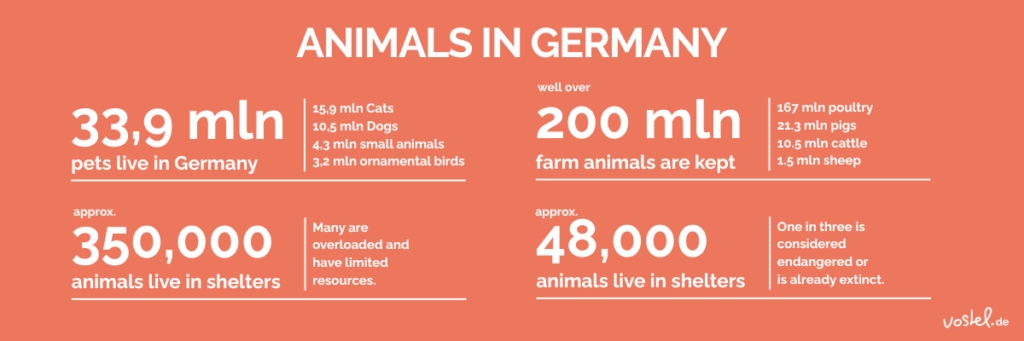
Around 33.9 million pets live in around 44 percent of all households, including around 15.9 million cats and 10.5 million dogs as well as 4.3 million small animals and 3.2 million ornamental birds (further figures on other animal species can be found at Zentralverband Zoologischer Fachbetriebe).
Animals at the shelter
Every year, an estimated 350,000 animals are cared for in German animal shelters (source: Deutschlandfunk, projection on animal shelter admissions). These include dogs, cats and other small animals that have been abandoned, surrendered or found. Resources are often very scarce and many animal shelters are overcrowded, which is why the support of volunteers is an important pillar of support.
Wild animals
In total, there are around 48,000 animal species in Germany. Around one in three animal species is considered endangered or already extinct, which corresponds to around 35 percent of the species assessed. Particularly affected are insects, birds and many amphibian species, whose habitats are increasingly being lost (source: Federal Government – Biodiversity and Species Conservation).
Farm animals
The situation of farm animals is also a key issue in animal welfare. At the end of 2024, around 10.5 million cattle, 21.3 million pigs and around 167 million poultry were kept in Germany. Questions about species-appropriate husbandry, space and health care are at the heart of social debates and the work of many animal welfare organizations (source: BMEL statistics on animal husbandry).
2. How organizations & volunteers get involved in animal welfare
What non-profit organizations do
Non-profit animal welfare organizations take in animals in need, organize medical care, provide care, support and placement and work to ensure species-appropriate living conditions. Many also carry out important educational work, provide information on responsible animal husbandry and draw attention to abuses. For many initiatives, campaigning for better legal conditions is also part of animal welfare work.
Important organizations include the Deutsche Tierschutzbund with its affiliated animal shelters, Vier Pfoten, PETA Germany, NABU, BUND, Animals’ Angels and also local animal shelters or animal rescues in many German cities. In addition, numerous smaller associations and initiatives are involved locally, for example for street cats, injured wild animals or the protection of certain animal species.
How volunteers are involved
Volunteers provide support by working directly with animals at the shelter, for example by walking, grooming, training or caring for dogs, cats or small animals. This often creates routines, trust and closeness that noticeably improve the animals’ everyday lives.
There are also many activities that do not involve direct contact with animals. Volunteers provide support with organizational tasks, at events and information stands or are involved in public relations work, for example as part of campaigns. This work ensures that animal welfare becomes visible and that organizations can further develop their services.
Typical fields of voluntary work in animal welfare
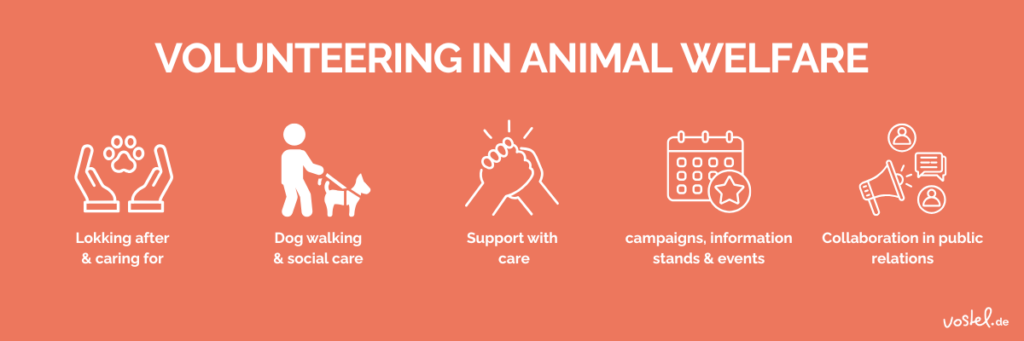
Volunteers can get involved in animal welfare in a variety of ways, for example:
- Looking after and caring for animals in animal shelters or rescue centers
- Walking, occupation and social care of dogs
- Support with the care of cats, small animals or wild animals
- Help with campaigns, information stands and events
- Collaboration in public relations, for example in social media, campaigns or fundraising activities
- Organizational support in the background, for example with appointments, administrative tasks or mediation processes.
3. What you should look out for when volunteering in animal welfare

Volunteering in animal welfare means becoming part of an existing team. Volunteers work together with full-time employees and other volunteers and are in regular contact with the organization. Questions, uncertainties or observations are discussed together so that you are supported as you grow into your commitment.
Time commitment and obligation
The time frame varies depending on the task. Some volunteers take on fixed tasks such as regular walks or looking after certain animals. Others provide selective support with campaigns, events or organization. It is important that your commitment fits in well with your everyday life and is clearly agreed so that processes at the animal shelter remain reliable.
Responsibility in handling animals
Each animal has its own history, needs and individual behavior. Volunteers learn to observe animals carefully, recognize signals and treat them with respect. The focus is always on safety, calm and the welfare of the animals. Questions and coordination with the team are a matter of course.
Exchange of experiences and observations
Working with animals can be touching, challenging and sometimes thought-provoking. This is why the exchange with the people at the animal shelter is particularly important. Experiences, uncertainties or observations are shared and classified within the team. This creates space for reflection, support and joint learning.
Patience and empathy for each individual animal
There are no quick fixes in animal welfare. Trust often develops slowly and every animal reacts differently. Patience and empathy help us to respond to an animal’s individual personality and give it the time it needs. This attitude characterizes the cooperation in the team as well as the handling of the animals themselves.
4. Find your volunteer position in animal welfare on vostel.de
On vostel.de you will find a wide range of opportunities to volunteer in animal welfare. Here you can discover organizations that are looking for support and projects where you can help animals.
FAQ – Frequently asked questions about volunteering in animal welfare
Do I need previous experience to volunteer in animal welfare?
No, you don’t need any previous experience to get involved in animal welfare. Many organizations explain procedures step by step and show you which tasks are right for you. The most important things are reliability, interest and respectful treatment of animals.
Can I volunteer without having direct contact with animals?
Yes, not all volunteer work in animal welfare takes place directly with animals. Many organizations are looking for support with campaigns, events, public relations work or organizational tasks in the background.
How much time do I need to set aside for voluntary work in animal welfare?
This varies greatly. Some commitments are regular, others are temporary or flexible. On platforms such as vostel.de, you can search specifically for projects that suit your time budget.
Is it possible to volunteer in animal welfare alongside work or study?
Yes, many projects are designed in such a way that they can be easily combined with work, studies or family life. Flexible or project-related commitments in particular offer a low-threshold entry point.
Who is particularly suited to voluntary work in animal welfare?
Volunteering in animal welfare is suitable for people who want to take on responsibility, have patience and want to work for the welfare of animals. Even if you would like to try out whether this area suits you first, there are suitable entry-level offers.
Your vostel.de team wishes you lots of fun with your voluntary work in animal welfare!







No Comments yet!