
Volunteering with homeless people: What you can expect
Homelessness affects tens of thousands of people in Germany who live permanently on the streets. In total, over one million people are homeless, many of them in emergency or shared accommodation. The numbers have been rising for years and for those affected this often means insecurity, health problems and social exclusion.
At the same time, many organizations and volunteers are committed to supporting homeless people in their everyday lives. In this article, you will find out what the situation is like in Germany, what help is available and how you can get involved in volunteering yourself.
Contents:
1. The situation of homeless people in Germany
What do homelessness and being homeless mean?
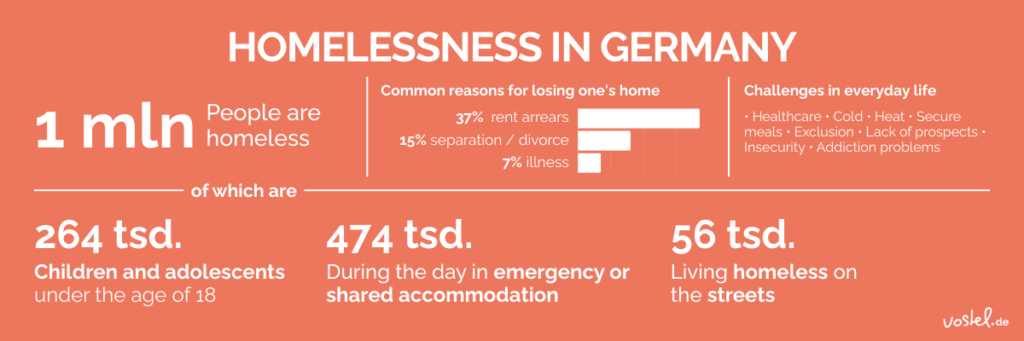
According to estimates by the Bundesarbeitsgemeinschaft Wohnungslosenhilfe (BAG W), over one million people in Germany were homeless in 2024. This means they had no tenancy agreement of their own and no secure accommodation. Around 264,000 of them were children and young people under the age of 18, mostly together with their parents.
Homelessness encompasses different living situations. Many people live temporarily with friends or family. Others are housed in emergency or shared accommodation. According to the Statistisches Bundesamt, around 474,700 people were registered in shelters as of January 31, 2025, an increase of around 8% compared to the previous year.
Around 56,000 people are considered homeless without any kind of shelter, living permanently on the streets. This article focuses primarily on those living in public spaces or in emergency accomodactions, as their situation is particularly stressful without a safe haven.
Why do people lose their homes?
In most cases, it starts with a crisis. This can be rent or energy debts, a separation, violence in the partnership, an illness or the loss of a job. If, in this situation, the rent can no longer be paid or a tenancy is terminated, people lose their home.
According to the Bundesregierungs latest homelessness report, rent and energy debts are the most common reasons for losing a home (around 37% of cases). Other reasons include separation or divorce (around 15 percent) and illness (around 7 percent).
Structural factors exacerbate the situation
Rising rents, a lack of affordable housing, poverty, mental illness, addiction or bureaucratic hurdles in accessing social benefits increase the risk of losing your own home.
Gender-specific dependencies also play a role. If women are financially dependent on their partner or do not have a tenancy agreement, they often lose their home in the event of a separation, often in connection with domestic violence. Without their own income or support, they quickly find themselves homeless.
What challenges characterize the everyday lives of homeless people?
The lives of homeless people entail extreme burdens that go far beyond the lack of a roof. These include:
- Health risks due to cold, heat and lack of places to retreat to
- More difficult access to medical care
- Lack of access to regular, healthy meals
- Exclusion, stigmatization, social isolation and loneliness
- Constant uncertainty and lack of planning prospects
- often also psychological stress due to addiction problems
2. How organizations & volunteers support homeless people

What non-profit organizations do
Throughout Germany, social organizations, associations and initiatives are committed to supporting homeless people and improving their living conditions. They offer both acute support and long-term assistance.
The best-known players include organizations such as Caritas, the diaconia, the Johanniter, the Malteser and regional organizations such as the Berlin City Mission and many smaller initiatives.
In addition to acute help, they also offer those affected long-term support:
- Everyday needs: food banks, clothing stores and warming centers
- Medical care: Health care, psychosocial support and hygiene services
- Housing: day centers, emergency overnight stays, housing projects and transitional offers
- Mobile services: outreach street workers, cold weather buses in winter, mobile shower buses, mobile clothes banks
- Advice & support: social counseling, support with authorities and applications, housing search, health insurance registration, job search or addiction counseling
The services go beyond mere emergency care. The aim is to stabilize people in their everyday lives and get them back into secure housing and living conditions in the long term.
How volunteers are involved
As a volunteer, you can provide support in direct contact with homeless people, for example when serving food, in day centers, accompanying them to appointments or in personal conversations. There you give time, listen and help in everyday life where support is needed.
There are also many tasks without direct contact. For example, you can be active in organizing offers, sorting donations, at events or in public relations. These activities ensure that support services can be reliably provided and continued.
Typical areas of voluntary work with homeless people
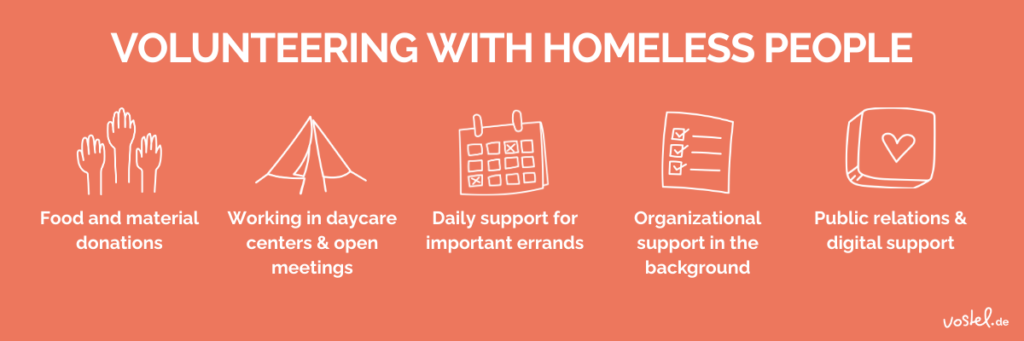
As a volunteer, you can get involved in a variety of ways, for example:
- Support with food and material distribution: You will help with the preparation and distribution of meals, drinks, clothing or toiletries and ensure that people are provided for in an uncomplicated manner. You can also get into conversation and lend a sympathetic ear.
- Work in day centers and open meeting places: You support open activities, prepare drinks or small meals, help with organizational tasks and are the contact person on site.
- Everyday support: You provide support with doctor’s appointments, visits to the authorities or orientation in the help system, always coordinated with full-time teams (e.g. Berliner Stadtmission, Housing First projects).
- Organizational support in the background: You help with sorting donations, preparing offers or with logistical tasks, even without direct contact with the visitors.
- Public relations and digital support: You support organizations with social media, texts, research or website maintenance and thus help to raise awareness of the issue of homelessness.
3. What you should look out for when volunteering with homeless people

Meet people on equal terms
Homeless people have very different life stories. It is important to treat them respectfully, openly and without prejudice. Openness helps you to understand the realities of life that are very different from your own.
You don’t have to “solve” anything
Volunteering is not about solving problems or finding quick solutions. It is often worth a lot just to give time, listen or provide support in everyday life.
Be mindful of your own limits
Encounters can be emotionally touching or challenging. It is perfectly okay to be aware of your own boundaries and to speak to your caregiver if you have any questions or uncertainties.
Reliability is important
Many services for homeless people rely on fixed schedules. If you get involved, you should stick to agreements and show up reliably for appointments.
Take advantage of the organization’s support
You are not alone as a volunteer. Full-time employees provide guidance, clarify tasks and are available as contact persons. Don’t be afraid to ask questions or ask for support.
4. Find your volunteer work with homeless people on vostel.de
If you would like to volunteer for homeless people, you will find a wide range of suitable volunteering opportunities on vostel.de. Simply search for projects that suit you in terms of time and activity.
FAQ – Frequently asked questions about volunteering with homeless people
Do I need previous experience to volunteer with homeless people?
No previous experience is required for many jobs. What is important is openness, reliability and a willingness to treat people with respect. The organizations usually prepare you well for your task.
How much time do I need to set aside, and is it possible to get involved at short notice?
The amount of time required depends on the project in question. Some assignments, such as serving food or sorting donations in kind, only last a few hours. Others, such as everyday support or emergency overnight shifts, take place regularly, for example once a week.
Do I have direct contact with homeless people?
It depends on the project. Some activities involve a lot of personal contact, others take place more in the background. You can decide for yourself which form of involvement is right for you.
How should I interact with homeless people?
Respect, openness and meeting people at eye level are key. You meet people with individual life stories. Listening and taking them seriously is often more important than advice or solutions.
What concrete impact does my commitment to homeless people have?
You directly support people in a difficult life situation in their everyday lives. Whether through a conversation, practical help or reliable support with offers, your commitment helps to create stability and reduce social isolation. Even a limited commitment can make a noticeable difference for individual people.
Discover more articles from our series #VolunteeringExplained

Your vostel.de team wishes you every success with your voluntary work with homeless people!







No Comments yet!