
Volunteering in Climate and Nature Conservation: What to Expect
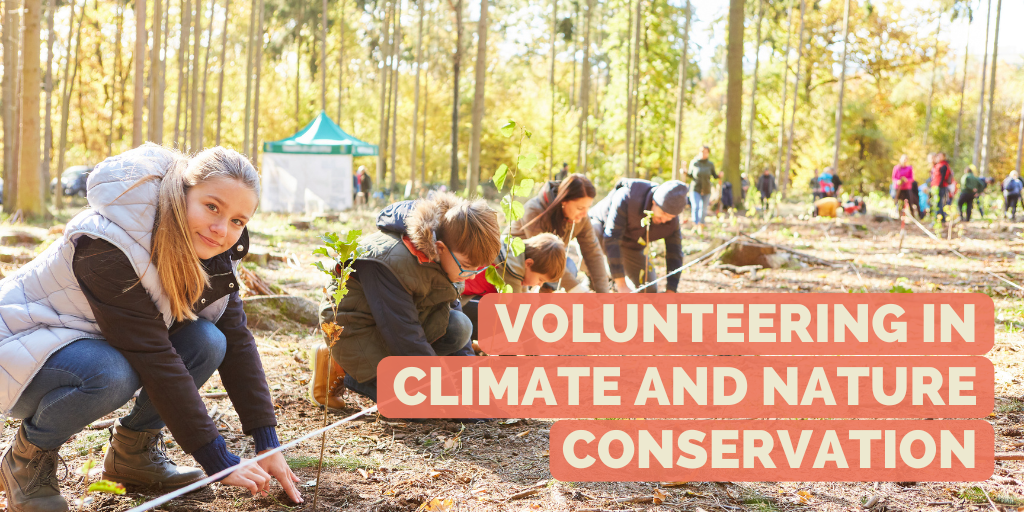
Thousands of people in Germany volunteer for climate and nature every day: they plant trees, get involved in environmental education, clear garbage from parks and forests or support local environmental protection projects. Together, they show that everyone can make a contribution to climate and nature conservation. Would you like to get active too, but don’t know how?
In this article, you will find out what the situation is like for climate and nature in Germany, which organizations are involved and what you can actually do as a volunteer.
Contents:
- Climate & nature conservation in Germany
- How organizations and volunteers protect the climate and nature
- What you should look out for when volunteering in climate and nature conservation
- Find your volunteer position in climate and nature conservation at vostel.de
- FAQ – Frequently asked questions about volunteering in climate and nature conservation
1. Climate & nature conservation in Germany
Climate and nature conservation in Germany covers various areas, which we will look at in more detail below to get a picture of the current situation and the challenges.
Germany’s forests in transition
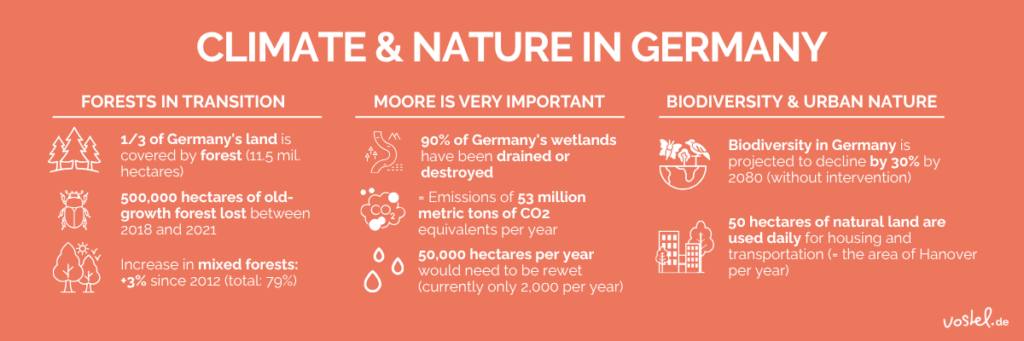
One third of Germany’s land area, i.e. around 11.5 million hectares, is covered by forest (Bundeswaldinventur 2024, BMEL). The forest area has increased slightly since 2012, but the condition of many trees is worrying:
The extreme drought summers between 2018 and 2020 hit the forest hard. Between January 2018 and April 2021 alone, more than 500,000 hectares of older forest area were lost according to DLR analysis, which is around five percent of the total German forest area(Wikipedia/BWI). Spruce, long the most common tree species, has suffered massively due to bark beetle infestation and drought, reducing its area share by 17 percent.
Forest conversion shows first successes
The good news: The transition to more species-rich mixed forests is making progress. According to the fourth Bundeswaldinventur (BMEL, 2024), mixed forests now cover 79 percent of Germany’s forest area, an increase of three percentage points since 2012. The area covered by deciduous trees has increased by seven percent over the same period.
In addition, the amount of deadwood has increased by a third, which is particularly important for nature conservation and biodiversity. 77 percent of forests now have two or more layers. 91 percent of the young, renewable forest is the result of natural regeneration, i.e. without separate sowing or planting, and is significantly more natural than older stands.
Germany’s moors: drained, but not lost
Peatlands are important carbon reservoirs and habitats for highly specialized animal and plant species. Although they only cover three percent of the world’s land area, they store twice as much carbon as all of the world’s forests combined (NABU). In Germany, the situation is critical:
- Bogs originally covered around five percent of Germany’s land area
- Today, over 90 percent of these areas are drained or destroyed (NABU, DEHSt)
- Drained peatlands in Germany account for approximately 53 million metric tons of CO₂ equivalents annually, representing about seven percent of Germany’s total greenhouse gas emissions (Heinrich-Böll-Stiftung)
In order to achieve the climate targets, at least 50,000 hectares of moorland would have to be rewetted every year, currently around 2,000 hectares per year (Klimareporter)
Loss of species diversity & biodiversity
One of the most pressing problems of our time is the loss of biodiversity. According to a study from 2023 (PLOS One), one in five animal and plant species in Europe is already threatened with extinction in the coming decades. For Germany, the Federal Environment Agency estimates that the diversity of native animal and plant species could decline by up to 30 percent by 2080 if global warming continues unabated (NABU).
The main drivers of this loss:
- Destruction and fragmentation of habitats due to land sealing and intensive land use
- Use of pesticides that endanger insects and thus entire food chains
- Rising temperatures and changing precipitation patterns due to climate change
- Drainage of moors and wetlands, which are essential habitats for specialized species
Cities need more greenery
Around 90 percent of people in Germany live in cities with a population of at least 5,000 (Umwelt im Unterricht/UBA). This makes urban nature the most direct point of contact with nature in everyday life for most of us. Green spaces cool the urban climate, filter air, store rainwater and provide a habitat for animals and plants. However, the pressure on these areas is growing: in Germany, over 50 hectares of land are used for settlements and traffic every day, which is equivalent to the area of a city like Hanover every year (Deutsche Umwelthilfe, 2024).
Deutsche Umwelthilfe’s 2024 heat check of 190 German cities with more than 50,000 inhabitants shows that 24 cities received a red card because they are both heavily sealed and offer too little cooling green space. Socially disadvantaged neighborhoods are particularly affected, where greenery is most often lacking.
Climate neutrality by 2045 requires major efforts
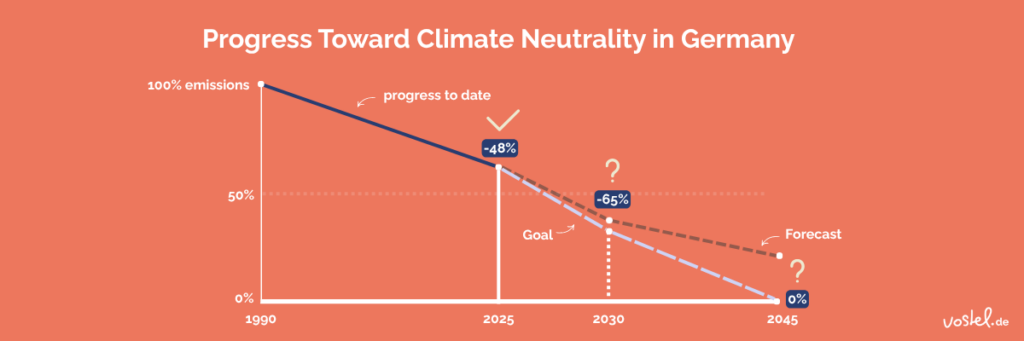
Germany has set itself the goal of becoming climate-neutral by 2045. By 2025, emissions have already been reduced by around 48% compared to 1990 levels, and by 2030 the target is at least 65%. The first half of the reduction has thus been achieved, but the second half will be much more challenging.
Current forecasts predict that it will not be possible to achieve climate neutrality by 2045 on the current course. In order to meet these climate targets, commitment and voluntary work will provide important impetus, although the majority of the responsibility lies with politics and business (Umweltbundesamt, 2025).
2. How organizations and volunteers protect the climate and nature
What non-profit organizations do
Non-profit organizations and initiatives are the backbone of climate and nature conservation in Germany. They carry out educational work, develop educational programs, maintain protected areas, engage in political lobbying and, if necessary, take legal action to enforce environmental law.
The largest environmental protection organizations in Germany:
NABU (Nature and Biodiversity Conservation Union Germany) has over 940,000 members and supporters, making it the largest nature conservation organization in the country. Around 85,000 volunteers carry out around three million hours of voluntary work every year, from maintaining protected areas to bird watching and environmental education with children.
BUND (Bund für Umwelt und Naturschutz Deutschland) has a nationwide presence with more than 2,000 local chapters. Its focus is on practical conservation work, such as the maintenance of orchard meadows and wetlands, as well as on political advocacy for organic farming, species conservation, and the protection of forests and waterways.
Greenpeace Deutschland relies on high-profile campaigns and direct actions to draw attention to problems in politics and business. Volunteers can get involved in local groups or support digital campaigns.
Deutsche Umwelthilfe (DUH) combines environmental and consumer protection and is known for enforcing environmental law in court. Among other things, it advocates for clean air, healthy ecosystems, and sustainable mobility, and has successfully fought for the introduction of a can deposit system and diesel driving bans in German cities. Support our campaigns.
Climate protection and climate education
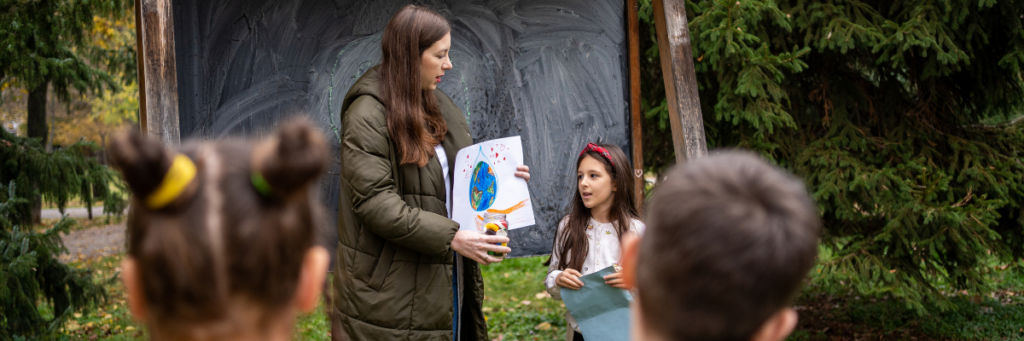
In the field of climate protection GermanZero with its project LocalZero project, where volunteers help to make their own city or municipality climate-neutral step by step through municipal climate protection plans and local political work. The organization Acker e.V. focuses on environmental education for children: volunteer AckerCoaches help school classes to plant their own vegetable patches and thus develop a direct relationship with food, nature and climate protection.
Tree and plant care
Smaller, local initiatives also do important work: aufBuchen e.V. works with volunteers to plant and care for tree seedlings in Berlin’s Bucher Forst. The Klimazone Bremen-Findorff e.V. organizes urban gardening projects in which volunteers plant and maintain planter boxes. The Unionhilfswerk Berlin Foundation is looking for support in looking after a neighborhood garden. And at the AWO Kreisverband Köln volunteers can lend a hand with gardening work in a children’s home or with local nature conservation projects.
How volunteers are involved
As a volunteer, you can get directly involved in nature: in planting campaigns, maintaining protected areas, clean-up missions or environmental education with children and young people. There you can get involved, experience the impact of your work directly and contribute directly to the protection of habitats.
There are also many tasks that are just as important but do not necessarily take place outside. For example, you can support organizations in public relations, in the coordination of events or through digital engagement. These activities ensure that projects run reliably and reach more people.
Typical areas of voluntary work in the field of climate and nature conservation
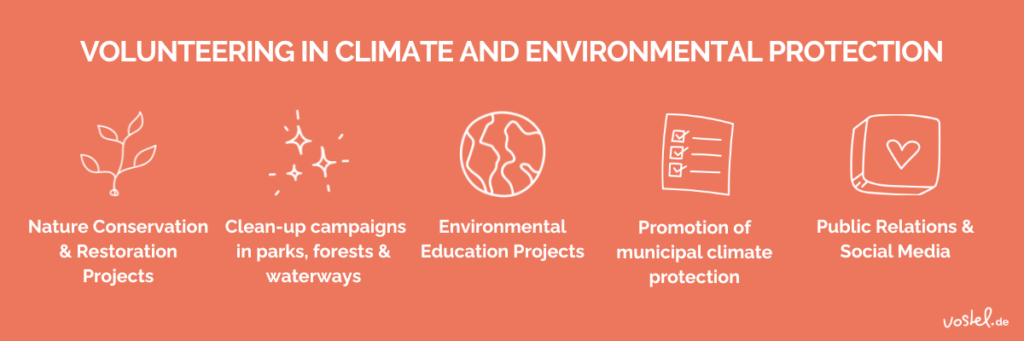
Volunteers can get involved in climate and nature conservation in a variety of ways, for example:
- Nature conservation: maintenance of conservation areas, neighborhood gardens or urban trees, assistance with renaturation projects or toad protection.
- Cleanup campaigns: Collecting garbage from parks, forests or bodies of water, also as plogging (jogging and picking up garbage) in everyday life.
- Environmental education: getting children and young people interested in nature through nature tours or school projects.
- Promotion of climate protection: collaboration on municipal climate protection plans.
- Communication & public relations: social media, newsletters, information materials for environmental organizations, designing online campaigns or editorial work.
3. What you should look out for when volunteering in climate and nature conservation

No knowledge of nature is required
One of the most common barriers to volunteering is the fear of not knowing enough. The same applies in climate and nature conservation as in most other areas of volunteering: Previous knowledge is welcome, but not a prerequisite. Only the desire and willingness to do something for nature should be present. Those who take part learn through practice, from experienced volunteers and from organizations that generally introduce and support their volunteers.
Scope and Getting Started: How to Find the Right Project
There is a wide range of environmental protection projects that you can support. A few questions will help you find the right format:
Find a climate & nature conservation project that suits you
To ensure that your commitment feels right and that you stick with it in the long term, it’s worth asking a few questions before you get started:
- What suits me? Do you prefer to be outdoors and get stuck in physically, or do you prefer to get involved in communication or organization?
- How much time do I realistically have? A one-off cleanup is just as valuable as a weekly commitment, as long as it fits in with your daily routine.
- Local or location-independent? Many projects take place directly in your city, others can be supported from home.
- Is the organization a good fit for me? A quick look at an organization’s values and way of working will help you find an environment in which you feel comfortable.
- Is there an introduction? Good projects accompany their volunteers and don’t let you jump in at the deep end.
4. Find your volunteer position in climate and nature conservation on vostel.de
Want to get active? On vostel.de you will find a large selection of projects in the field of climate and nature conservation, from one-off clean-up campaigns to regular nature conservation and environmental education for children. The projects come from all over Germany and can be filtered by location, time commitment and field of activity so that you can quickly find what suits you.
5. FAQ – Frequently asked questions about volunteering in the field of climate and nature conservation
What is the difference between climate protection and nature conservation?
Climate protection aims to reduce greenhouse gas emissions and limit global warming. Nature conservation focuses on preserving ecosystems, habitats and biodiversity. The two areas are closely linked: Intact nature protects the climate, and a stable climate protects nature. In voluntary work, the boundaries are often blurred.
Can I volunteer from home as well?
Yes, in addition to many local projects, there are also location-independent opportunities, such as digital support for environmental organizations in social media or public relations work, editorial work or helping to design information materials.
Which organizations can I support in the area of climate and nature conservation?
The selection is large. The best known include NABU, BUND, GermanZero and Acker e.V. In addition, there are many local initiatives and projects that are also urgently looking for support. On vostel.de you will find projects from organizations all over Germany collected in one place.
What difference does my volunteer work really make?
A concrete and measurable contribution. At NABU alone, around 85,000 volunteers perform around three million hours of voluntary work every year. Every tree seedling planted, every cleanup campaign, every child who learns how vegetables grow from an AckerCoach is a direct contribution to protecting nature and the climate. What’s more, volunteering keeps society’s awareness of the issue alive, even when it fades into the background politically and in the media.
Discover more articles from our series #VolunteeringExplained

Your vostel.de team wishes you valuable experience in your voluntary work for climate and nature conservation!






No Comments yet!