
Volunteering in Civil Protection: What to Expect
Floods, storms, wildfires, or power outages—there are many scenarios in which civil protection teams are called into action. What many people don’t know is that 94% of the organizations involved rely on volunteers. Nearly two million people in Germany volunteer for civil protection, and yet the need is growing faster than the number of volunteers.
In this article, you’ll learn how civil protection is organized in Germany, which organizations and volunteers play a role in it, and what you should keep in mind if you want to get involved.
Contents:
- Civil Protection in Germany
- How organizations and volunteers help with Civil Protection
- What to keep in mind when volunteering in Civil Protection
- Find a volunteer opportunity in Civil Protection on vostel.de
- FAQ – frequently asked questions about volunteering in Civil Protection
1. Civil Protection in Germany
What is Civil Protection?
Civil Protection refers to all measures taken during extraordinary incidents to protect lives, health, the environment, and property. It comes into play when regular fire and rescue services alone are no longer sufficient: in the event of widespread flooding, mass casualty incidents, large-scale power outages, or the failure of critical infrastructure such as water and telecommunications systems.
Disaster management is part of the broader civil protection system, which in Germany consists of two pillars:
- Civil Protection which is the responsibility of the federal states.
- Civil defence, organised by the federal government in the event of a defence emergency.
In everyday life, it is primarily civil protection that comes into play during natural disasters, industrial accidents, or pandemics.
Why is it becoming more and more important?
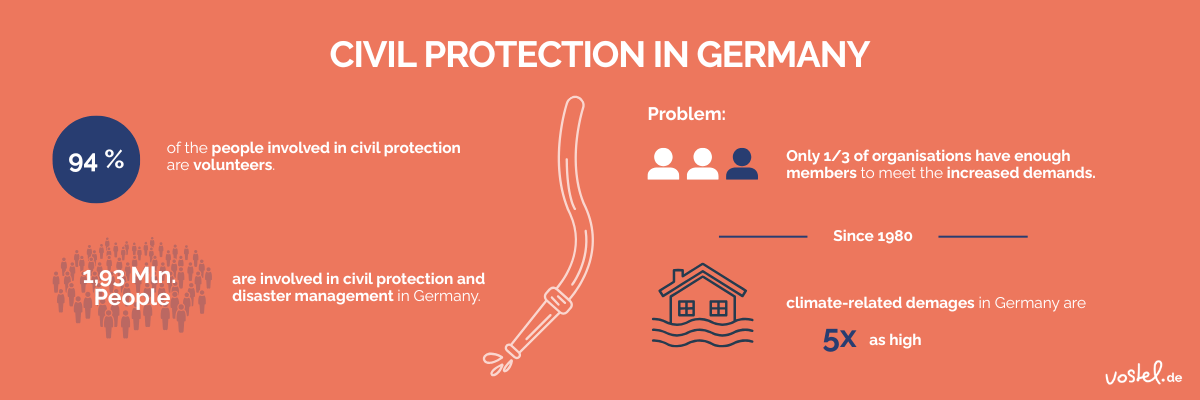
Germany is not a high-risk country by global standards, but the situation is changing. Since 2000, weather-related natural disasters and the resulting damage have been increasing significantly in this country (German Climate Consortium, 2025). The flooding in the winter of 2023 and the severe rainstorms in the summer of 2024 have shown how quickly entire regions can find themselves in distress. A position paper by the German Insurance Association from December 2025 states that climate-related damage in Germany has increased fivefold since 1980 (ZDF, January 2026).
Climate change not only increases the frequency of such events but also their intensity. For disaster management, this means more operations, longer operations, and more complex situations. Added to this are new threat scenarios, such as widespread failures of critical infrastructure, to which the system is only now adapting (BBK, Climate Change and Civil Protection).
Volunteer work as a cornerstone
This system functions almost entirely thanks to volunteer efforts. According to a 2025 study by ZiviZ at the Stifterverband, commissioned by the Federal Office for Civil Protection and Disaster Assistance, 1.76 million adults in Germany volunteer in civil protection and disaster relief. If we include young people between the ages of 14 and 17, the total rises to just under 1.93 million—about three percent of the German population (ZiviZ at the Stifterverband, “Engagement im Ernstfall,” April 2025).
Staff shortages in many areas
At the same time, pressure on organizations is mounting: Only just under a third of active organizations report having enough members to meet the increased demands. Leadership positions remain unfilled in many places, yet only 11 percent of organizations have paid staff (ZiviZ at the Stifterverband, “Engagement im Ernstfall,” April 2025). Civil protection in Germany is therefore heavily reliant on people who volunteer their time, and this need is growing.
2. How organizations and volunteers help with Civil Protection
An overview of the most important organizations
Civil protection in Germany is not a single system, but rather a network of various organizations with different areas of focus. Here is an overview of the most important ones:
- Volunteer Fire Department: By far the largest pillar of Germany’s disaster response system. Volunteers handle firefighting, technical rescue, search and rescue, and environmental protection measures—such as in the event of oil or chemical spills. Many municipalities would be unable to function without the volunteer fire department.
- Technical Relief Service (THW): A federal agency that is 99 percent volunteer-run. Approximately 88,000 volunteers in 668 local chapters provide technical assistance, including flood protection, emergency bridges, debris removal, emergency power supply, and rescue operations.
- German Red Cross (DRK): Germany’s largest aid organization. Volunteers provide support in medical services, social services, water rescue through the Water Rescue Service, and youth programs.
- Johanniter-Unfall-Hilfe: Provides medical and support services, assists at large events, and offers disaster relief. People often get involved through the Johanniter Youth program, which includes first-aid training.
- Malteser Hilfsdienst: Focuses on medical services, care, and psychosocial emergency care. Offers a wide range of training programs for beginners.
- Arbeiter-Samariter-Bund (ASB): Active in medical and support services as well as in emergency response, with a strong focus on first aid and emergency assistance.
- German Life-Saving Association (DLRG): The world’s largest water rescue organization. Volunteers are active in flood response operations, along bodies of water, and in public warning efforts—for example, using loudspeaker trucks when there is a risk of storm surges.
What these organizations have in common is that they all rely on volunteers who undergo regular training, attend drills reliably, and step in when an emergency arises. The tasks involved are extremely diverse:
What volunteers actually do
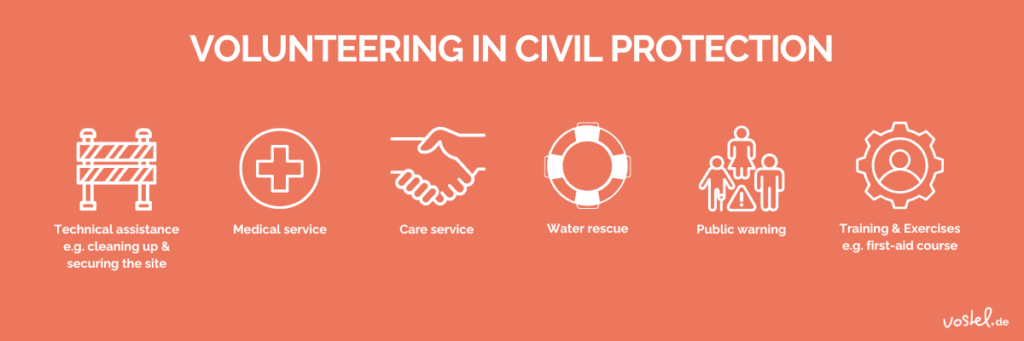
The areas of activity in disaster response are as diverse as the emergency situations themselves. Here is an overview of typical tasks:
- Technical assistance: Hauling sandbags, setting up pumps, building temporary bridges, clearing debris, ensuring power supply
- Medical Services: Providing first aid to the injured, medical care during major disasters and at events
- Support Services: Providing care, support, and assistance to evacuees in emergency shelters
- Water Rescue: Flood Response, Lifesaving, Boat Operations
- Public Alert: Inform and warn residents of an imminent danger
- Training & Drills: Orienting new members, leading first-aid courses, training together for emergencies
Those who volunteer contribute not only their time and energy, but often also specific skills from their professional lives—whether as a doctor, engineer, logistics specialist, or IT professional. Many organizations actively seek out such skills.
3. What to keep in mind when volunteering in Civil Protection
No prior knowledge required, training provided
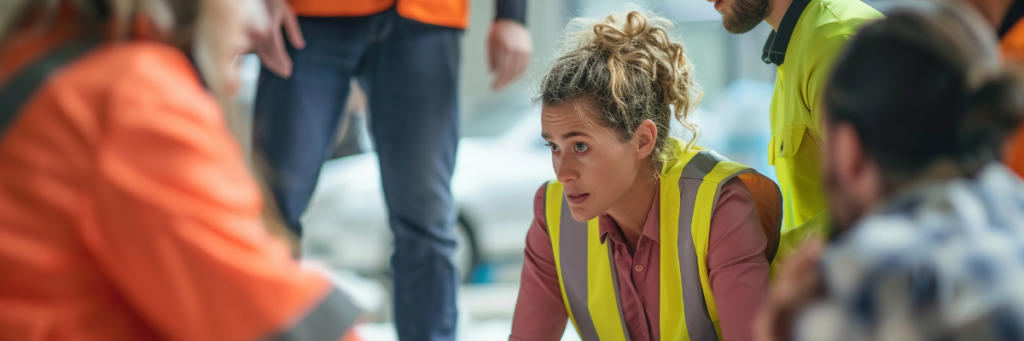
The most common misconception about disaster response is that you have to know how to do something before you start. That’s not true. All major organizations train their volunteers themselves, from first-aid courses and medical training to specialized technical training. Most organizations make it easy to get started; it often begins with an introductory evening or an initial meeting at the local chapter.
If you already have skills from your professional life—such as medical knowledge, technical skills, IT expertise, or experience in logistics—you can put them to good use. But even without these qualifications, you’re welcome to join us. What matters most is reliability, the ability to work as part of a team, and a willingness to learn.
Assess the time required realistically
Volunteering in disaster response is not just an occasional commitment on an as-needed basis. Most organizations expect a certain level of regularity: training sessions, courses, and joint operations. According to the ZiviZ study “Engagement in Emergencies,” more than a third of active volunteers participate several times a week, and many devote more than five hours a week (ZiviZ at the Stifterverband, April 2025).
That sounds like a lot, but it doesn’t have to be that way from the start. Many local chapters are flexible and will tailor your involvement to your personal circumstances. When you first join, be open about how much time you can realistically commit. This sets clear expectations for both sides.
Leave of absence and insurance cover
Two practical questions that many people have: Am I insured while on an assignment? And do I have to take vacation time for this?
Regarding insurance: Volunteers in disaster response are covered by statutory accident insurance during operations, drills, and training sessions. The exact regulations vary depending on the organization and federal state; if in doubt, the respective relief organization can clarify this directly.
Regarding time off work: For THW volunteers, time off from work is regulated by law. Section 3 of the THW Act requires employers to grant time off for deployments and drills; lost wages are reimbursed. Similar provisions apply to members of the volunteer fire department: In all federal states, they are granted time off for emergency responses, and the local municipality generally covers continued pay. For other aid organizations such as the German Red Cross (DRK) or the Johanniter, the regulations are less uniform and depend on the respective federal state and employer.
Finding the right organisation for you
THW, the fire department, the German Red Cross (DRK), Johanniter, Malteser, ASB, or DLRG: Which organization is right for you? That depends less on abstract preferences than on very specific questions: What interests you in terms of the work itself? Technical work, medical care, support, or water rescue? Is there a local chapter near you? And what’s the community like there?
A good first step is to visit the local chapter or regional chapter of the organization in question. Most offer introductory sessions or open practice sessions where you can get a feel for things before you commit. You can also use vostel.de to filter specifically for volunteer opportunities in disaster response and compare different projects and organizations.
Psychological stress and self-care
Disaster response operations can be emotionally challenging. Anyone who encounters people in acute distress, witnesses destruction, or has to act in stressful situations will not always come through it unscathed. This is normal and not a sign of weakness.
Many organizations therefore offer psychosocial support, such as debriefings, peer support programs, or access to professional counseling. It is important to actually take advantage of these services and to openly discuss any lingering effects of an operation. Equally important: knowing and respecting your own limits. A strong team within the local chapter helps everyone work through even difficult moments together.
4. Find a volunteer position in Civil Protection on vostel.de
On vostel.de, you can find volunteer opportunities in the field of civil protection and first aid throughout Germany. Whether it’s medical services, support, training, or technical assistance, you can filter by location, frequency, and German language proficiency to find the volunteer opportunity that fits your lifestyle.
5. FAQ – Frequently asked questions about volunteering in Civil Protection
What is the difference between civil protection, the fire service and the ambulance service?
These three areas complement one another but have different responsibilities. The fire department is primarily responsible for firefighting and technical rescue and is also a cornerstone of disaster response. The emergency medical services provide medical emergency care on a day-to-day basis. Disaster response kicks in when an incident is so large that these regular structures alone are no longer sufficient: in the event of flooding, mass casualty incidents, widespread power outages, or other large-scale disasters.
Do I need to be physically fit or have any prior experience?
Not necessarily. The requirements depend heavily on the specific role. Anyone involved in technical rescue operations—such as hauling sandbags or clearing debris—needs to be physically fit. Those working in support services—such as caring for evacuees or leading first-aid courses—don’t necessarily need it. All major organizations train their volunteers themselves; prior experience isn’t required. What matters most is reliability and the ability to work as part of a team.
Will I receive training before I have to go out on a mission?
Yes. No one is sent on a real mission without proper preparation. All organizations offer structured training programs that are built up step by step: from basic training to specialized courses and regular drills. The process usually begins with an introductory evening or a first-aid course.
How much time should I allow?
That depends on the organization and your area of responsibility. Regular training sessions, courses, and occasional assignments are all part of the job. According to the ZiviZ study “Engagement in Emergencies,” more than a third of active members volunteer several times a week. When you first join, it’s a good idea to have an open conversation with your local chapter about your availability.
Am I insured whilst on assignment, and will I be exempt from work?
Yes to both, with some restrictions. Volunteers in disaster response are covered by statutory accident insurance during operations, drills, and training. Regarding time off work: THW volunteers have a statutory right to time off work, and they are reimbursed for lost wages (Section 3 of the THWG). For members of the volunteer fire department, the municipality generally covers continued pay. For other aid organizations, the regulations vary by federal state.
Can I get involved even without being a full member?
Traditionally, volunteering in disaster response requires membership in an organization, because training, equipment, and operational readiness are organized through it. However, more and more organizations are opening up to more flexible formats. On vostel.de, you can also find project-based volunteer opportunities, such as helping with blood drives or first-aid courses, which don’t require a long-term commitment.
What should I do if an assignment is taking an emotional toll on me?
This is an important question, and it deserves an honest answer: Stressful deployments can take a toll. That’s why many organizations offer debriefings, peer support programs, or access to professional psychosocial counseling. Talk openly with your team about stress and take advantage of these resources. Knowing and acknowledging your own limits helps you protect yourself and stay effective in the long run.
Discover more articles from our series #VolunteeringExplained


No Comments yet!