
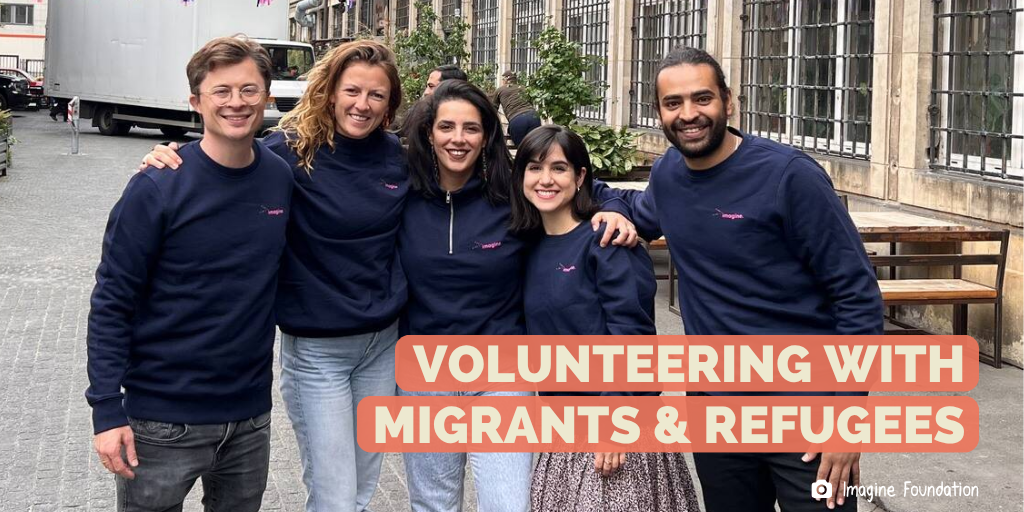
Volunteering with migrants & refugees: what you can expect
Migration is an integral part of society: around 25.8 million people with a history of migration live in Germany. And new people are arriving every day, moving to Germany for professional reasons, as refugees, for training or as part of family reunification. Many of them face similar challenges: Finding accommodation, bureaucracy and learning the language often don’t make the start in their new home country easy.
By volunteering with refugees and migrants, you can help them to settle in. In this article, you can find out what you can expect, which organizations you can get involved with and what you should look out for.
Contents:
- Migration in Germany
- How organizations and volunteers support migrants & refugees
- What you should look out for when volunteering with migrants & refugees
- Find your volunteer position with migrants & refugees on vostel.de
- FAQ: Frequently asked questions about volunteering with migrants & refugees
1. Migration in Germany
Migrants, refugees, newcomers: Who is meant?
The terms often overlap in everyday life, but refer to different groups.
- According to the Federal Statistical Office, people with a migrant background are all persons who themselves or at least one parent of whom was not born with German citizenship.
- Migrants is the generic term for all people who move from one country to another, voluntarily or involuntarily, permanently or temporarily.
- Refugees are a subset of this group: people who have had to leave their home country due to war, persecution or other threats.
- We also often use the term newcomer in our engagement: it is an open, appreciative term for all newcomers, regardless of the reason for their migration.
How many people live in Germany with migration or refugee experience?
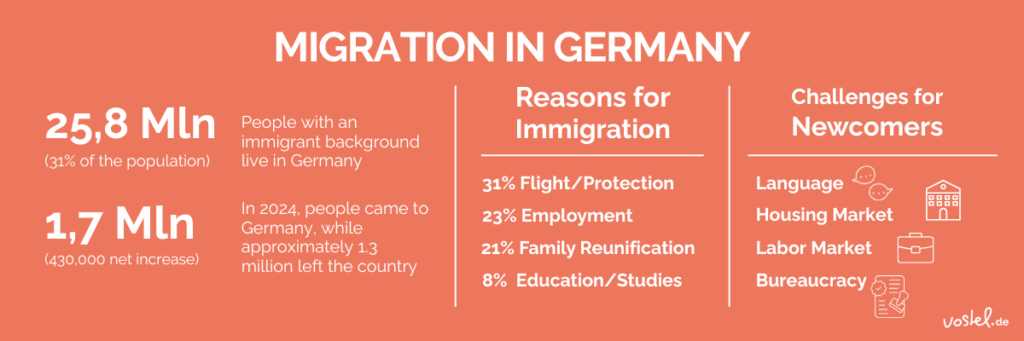
In 2025, around 25.8 million people in Germany will have a migration background, which corresponds to 31.1% of the total population. Of these, 16.4 million have immigrated themselves, i.e. almost one in five people in Germany. Among children and young people up to the age of 20, the proportion with a migrant background is as high as 43.1 percent.
In 2024, approximately 1.7 million people moved to Germany, about 430,000 more than the number who left the country. However, this meant that net immigration was below the average for the previous ten years, which was around 601,000 people per year.
The most important reasons for immigration since 2015 were flight, asylum and international protection (31 percent), employment (23 percent), family reunification (21 percent) and study and training (8 percent).
At the end of 2025, an additional 3.2 million people were registered as seeking protection, including over 1.3 million from Ukraine. (Sources: Destatis migration statistics 2024; Destatis / Mediendienst Integration, microcensus 2025; Destatis AZR 2025)
What role does migration play in our society?
Migration is a politically charged topic that is often reduced to problems and conflicts in the public debate. Yet the figures show that it is an important part of our society, because:
- The baby boomer generation is currently retiring en masse from working life, and the domestic labor force potential is falling by around 300,000 people per year according to DIW forecasts.
- In 2024, employment subject to social insurance contributions in Germany was already growing exclusively due to foreign nationals.
- People with a history of immigration now make up more than one in four of the country’s workforce and are significantly younger on average: 36.1 years compared to 47.6 years for people without a migration background.
- Immigration has high innovative power: in 2022, one in seven patent applications in Germany was already attributable to people with a migration background, compared to one in twenty in 2000. In addition, companies with culturally diverse teams have a significantly higher innovation rate and can respond better to global markets.
- Cultural and social diversity: Migrants bring different languages, perspectives and experiences that enrich our society, whether in schools, neighborhoods, clubs or in the workplace. Studies show that cultural diversity promotes collaboration and creative thinking.
(Sources: DIW Berlin 2025; Federal Institute for Population Research 2025; Institute of the German Economy 2024; IW study via migrando.de 2025)
Challenges for newcomers in Germany
As important as migration is for our society, the path to participation is a rocky one for many newcomers. A lack of language skills is often the starting point for many problems. But the hurdles go far beyond language:
- Housing: In an already tight housing market, newcomers often experience additional discrimination when looking for accommodation.
- Work: Long recognition procedures for foreign qualifications, lack of work permits and language barriers delay entry. Many therefore initially work far below their qualifications.
- Authorities: Complex administrative procedures and a lack of native speaker support make dealing with authorities and asylum procedures a real challenge.
- Risk of poverty: People with a migration background are more than twice as likely to be at risk of poverty as people without a migration background, due to discrimination, poorer access to education and more frequent employment in the low-wage sector.
- Psychological stress: Many refugees carry traumatic experiences of flight and persecution with them, which can make arriving even more difficult.
(Sources: Mediendienst Integration 2024, Statista / Destatis 2024; IAB / Markt und Mittelstand 2025)
Nevertheless, developments in recent years show that integration works if it is given time and support. Over 62% of those who have fled to Germany since 2015 are now employed, more than half of them in system-relevant professions such as healthcare, logistics or construction. (Sources: Rescue.org; IAB 2025)
Newcomers as volunteers: Commitment as a bridge
Many newcomers to Germany do not wait for support to come to them, but actively get involved themselves. More and more newcomers are volunteering because they want to give something back to society, because they want to make contacts and because volunteering is one of the best ways to practise the language in real life.
Research results from the FAU project EMILIE confirm this: Through their involvement, migrants contribute skills and talents that they would otherwise hardly be able to bring to bear, such as their multilingualism, intercultural competence or specific knowledge about their region of origin. Volunteering thus becomes a bridge in both directions. (Source: Kordel/Weidinger/Spenger, Wegweiser Bürgergesellschaft 07/2024)
2. How organizations and volunteers support migrants and refugees

What non-profit organizations do
In Germany, many different actors are involved in supporting and integrating migrants and refugees. In addition to government agencies, it is primarily non-profit organizations and charities that are active on the ground. The largest of these include
- Caritas: Migration advice, language courses, support in everyday life, volunteer exchange for volunteers
- Diakonie: Around 100,000 volunteers are involved in helping refugees in the church and Diakonie alone across Germany
- AWO: Operates accommodation in initial reception centers as well as hundreds of migration and integration services with German courses and socio-educational support
- DRK, Malteser, ASB, Johanniter: support in accommodation, care services, leisure activities
- Paritätischer Gesamtverband: Represents numerous smaller organizations with a wide range of services
- UN refugee aid: As the German donation partner of the UNHCR, it supports facilities and projects throughout Germany
Many organizations are also represented on vostel.de, including Johanniter-Unfall-Hilfe, the Berlin City Mission and the Munich Refugee Council.
How volunteers are involved
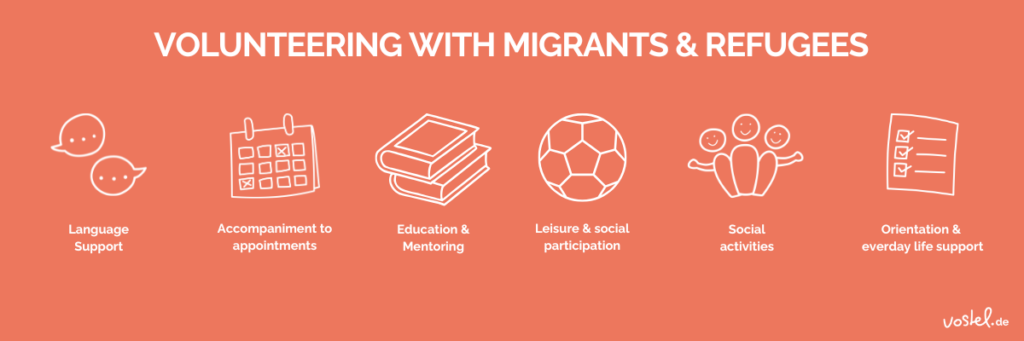
As a volunteer, you create personal encounters and genuine exchanges that give newcomers direct access to their new world. Your tasks can be very different:
- Language support & tandems: In language tandems, language cafés or informal discussion groups, you help newcomers to practise German in real life and become more confident.
- Accompanying people to appointments: You accompany people to appointments with authorities, doctors or government offices, where language barriers and unfamiliarity with the system can quickly become an obstacle.
- Education & mentoring: You support children and young people with their homework or help young people with a refugee or migrant background to enter training and work.
- Leisure & social participation: Joint excursions, city tours, sports activities or museum visits create connections and provide a low-threshold introduction to social life.
- Meeting opportunities: Open meetings, creative groups or workshops create space for exchange and networking, often the first step towards real friendships and local arrival.
- Orientation & everyday support: You will help you navigate your new everyday life, whether it’s finding accommodation, getting to know the local infrastructure or dealing with practical questions about settling in.
3. What you should look out for when volunteering with migrants & refugees
Getting involved with migrants and refugees is not a question of special qualifications, but above all a question of attitude. The following points will help you to start well prepared and make your engagement sustainable and effective.
Treat people as equals
The most important principle sounds simple, but is sometimes not so easy to implement in everyday life: Refugees and migrants are not a passive target group that needs to be helped, but people with their own experiences, strengths, wishes and the right to self-determination. Ask what someone needs instead of assuming they have needs. Listen before you act. Genuine contact at eye level only arises when volunteers recognize people’s individuality and leave room for their own perspective.
Be open to other cultures
Different cultural backgrounds can lead to misunderstandings that nobody intends. Before your assignment, find out a little about the living situation and cultural background of the people you are working with. At the same time, no culture is homogeneous and every person is more than their origin. Openness, curiosity and the willingness to question your own perspective are the best basis.
Build trust
Long-term commitments such as mentoring or sponsorships in particular take time to establish a real basis of trust. Commitment is crucial here: canceled meetings or sudden rejections can be particularly stressful for people who have already experienced a lot of uncertainty. Before you start, think about how much time you can realistically commit and communicate this clearly. Short-term or one-off commitments are also valuable, for example at open language cafés or leisure activities
Try to be trauma-sensitive
Many refugees have had difficult experiences during their flight or in their home country. This does not mean that you as a volunteer should become a therapist, that is not your job. But it does mean being sensitive: Don’t pressure anyone to talk about their past. Respond calmly and without judgment when difficult topics come up. And seek your own support if certain conversations or situations bother you.
Know your own limits
Volunteering depends on you enjoying what you do. Set yourself clear limits on what you can and want to do and stick to them. You are not responsible for solving all problems. Sometimes the most important thing you bring to the table is simply your time and attention.
Get involved through an organization
Especially at the beginning, it is advisable to volunteer through an established organization. This way, you will receive an introduction, support and a permanent contact person, your volunteering is usually covered by accident insurance through the organization and you can be sure that your support will go where it is needed. Platforms such as vostel.de help you to find suitable projects in your area.
4. Find your volunteer work with migrants & refugees on vostel.de
On vostel.de you will find a wide range of volunteering opportunities in this area, from weekly language support to educational sponsorships and open meeting opportunities. The projects come from all over Germany and are aimed at people with varying amounts of time and previous experience. Whether one-off or long-term, whether in Berlin, Munich or Freiburg: there is a suitable opportunity for almost every interest and every schedule.
5. FAQ: Frequently asked questions about volunteering with migrants & refugees
Do I need any special language skills to volunteer?
No, special language skills are not a prerequisite in most cases. Many activities, such as joint leisure activities, accompanying people on excursions or creative activities, also work without a common language. Of course, a good knowledge of German is helpful for activities such as language support or assisting authorities. On vostel.de, you can filter your search according to the required language level.
Can I volunteer on short notice or just once?
Yes, there are one-off as well as project-based and regular commitments. Open formats such as language cafés or leisure activities are well suited for an initial introduction without a long-term commitment. For activities such as mentoring or educational sponsorships, on the other hand, a certain continuity is important, as trust takes time.
Can I get involved if I have personal experience with migration?
Absolutely, and that is expressly encouraged. People with their own migration or refugee experience bring valuable perspectives, multilingualism and intercultural understanding. Volunteering is also a good way to make new contacts, practise the language and settle into a new environment.
Is this engagemant emotionally draining?
You may come into contact with difficult life stories and stressful situations during your engagement. This is normal and is not a sign that you are not suitable. It is important that you know where your own limits lie and get support if necessary. Most organizations have experienced contact persons who will accompany you. Speak openly if something is bothering you.
What is the difference between volunteer work and professional social work?
As a volunteer, you do not provide legal advice, therapeutic work or socio-educational support. That is the job of professionals. Your role is different, but just as important: you are a companion, a discussion partner, a learning partner or simply a trusted person in everyday life. This human closeness cannot replace professional support, but it can usefully complement it.
How do I find the right organization?
The easiest way is to search on vostel.de. There you can filter by location, field of activity, time required and language level and contact the organizations directly. Alternatively, you can also contact local volunteer agencies, refugee councils in the federal states or the advice centers of the major charities such as Caritas, Diakonie or AWO.
Discover more articles from our series #VolunteeringExplained
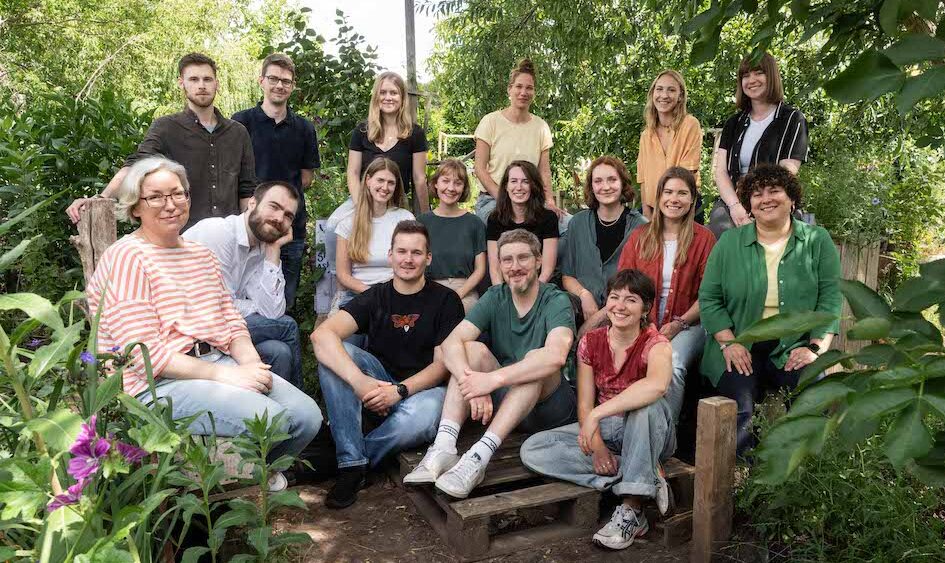
Your vostel.de team wishes you valuable experiences in your volunteer work with refugees and migrants!



No Comments yet!