
What does equal opportunity mean? Definition, Examples & Status Quo
Factors such as social and ethnic background, gender or religion still often determine educational pathways, job opportunities and social participation. For this reason, in this article we take a closer look at what the term equal opportunities actually means, what the situation is like in Germany and how it can be promoted both in society as a whole and on an individual level – e.g. through voluntary work via vostel.de.
Equal opportunity definition
The term equal opportunities describes an ideal state in society that should enable all people to achieve maximum success with their individual performance. This means that where there is competition between several people, everyone should have the same starting conditions. This applies to areas such as education, health, housing and, in general, the distribution of material and financial resources.
According to the idea fo equal opportunity, factors such as origin, gender, skin color and religious affiliation should have no positive or negative influence on a person’s chances of success. This has been regulated by law since 2006, namely in the General Equal Treatment Act (AGG). Among other things, the law states that no one may be discriminated against on the basis of their origin when looking for a place to live and that the application process for a job must be designed to be non-discriminatory.
Equal opportunity vs. equity: what is the difference?

Where do the terms originate?
In the 1960s, the word equal opportunity was first used in connection with the education crisis of the time, after Germany showed clear deficits compared to neighboring countries.. At that time, only 15% of the children in a given year attended a Gymnasium. Children from working-class households, children living in the countryside and women and girls in general had little access to higher education (more here). There was a call for a reformation of the education system, with equal educational opportunities for all.
But the concept of equal opportunity was soon criticized and labeled as “socialist egalitarianism” in politics. As a result, the CDU/CSU promoted the phrase equity of opportunity as an alternative term in which not “everyone should be given the same chance, but everyone should be given their chance,” according to the then CDU Minister of Education and Cultural Affairs Bernhard Vogel in 1974. You can read more about the history of the terms here.
How do they differ?
Equal opportunity means that resources must be distributed equally to everyone, regardless of individual background, so that everyone has the same starting chances and thus opportunities for advancement.
In the case of equity, on the other hand, resources are distributed only to those who need them. This is to create a balance and fair conditions for all. Although the terms equal opportunity and equity have different meanings, they are now often used as synonyms. In this paper, we use the term equal opportunity because it is more commonly used.
Equal opportunities in education
Education plays a central role in a person’s future standard of living, income, and social status, and continues to influence quality of life long after school ends. This is why there is the greatest need for action here, as studies make it clear that inequalities begin very early.
Current school system reinforces inequalities
A widely known fact is that children’s education is strongly dependent on that of their parents. Data from the IFO Opportunities Monitor study show that only about 21% of children with two parents without a high school diploma and a net household income of less than 2600 euros per month attend a high school. In contrast, 80% of children of parents who both have high school diplomas and have a combined net income of more than 5500 euros attend Gymnasium.
According to education researcher Klaus Klemm, the current school system contributes greatly to less equality of opportunity: “Germany’s daycare centers and schools do not reduce the division of society into winners and losers, but rather solidify it.”
Social background remains decisive for educational attainment
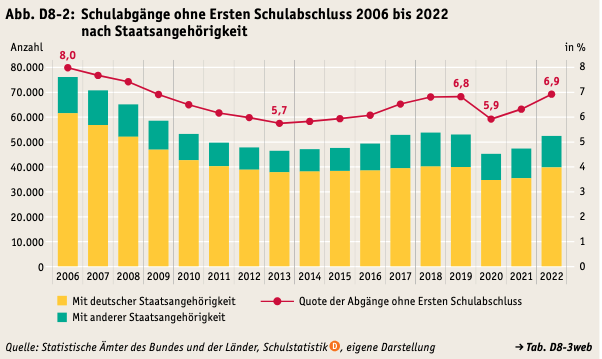
The 2024 National Education Report confirms these trends: children and young people from socio-economically disadvantaged families still have significantly poorer chances of successful educational attainment. Almost 7% of pupils leave school without a qualification, a figure that has risen again in recent years (as of 2022). In addition, children from socially disadvantaged households are much less likely to be recommended for grammar school than their peers from privileged families, even if their performance is comparable.
Inequalities are also evident in vocational training: although there are now more training places than applicants, access remains severely restricted for young people without a school leaving certificate or with only a secondary school leaving certificate. Around 17% of 25- to 34-year-olds currently have no vocational qualification, which significantly reduces their chances of finding stable employment.
Current situation in Germany
Unequal conditions are not only found in the field of education. To gain insight into the current situation in Germany, we explore three other areas as examples.
Health
The WIdO study ‘Social Disadvantages in the Education and Health System’ (2023) shows that education not only shapes career paths, but also has a significant impact on health. According to the study, people with lower levels of education are significantly more likely to suffer from chronic illnesses, mental health problems and lower life expectancy. At the same time, they are less likely to take advantage of preventive services such as screening tests or regular health checks.
The causes are not only individual behaviour, but also structural barriers in the health system, such as lower health literacy or language barriers. The study makes it clear that there have been few systematic approaches to effectively reducing these inequalities and that politicians and the healthcare system have a responsibility to make access to healthcare services more equitable.
Housing market
In terms of housing, many people face barriers to accessing affordable housing. According to the Federal Anti-Discrimination Agency, 35% of people with an immigrant background report they have experienced racial discrimination while looking for housing and have received rejections on job applications with above-average frequency. Not only is it significantly more difficult for them to find housing, but they are also more often forced to pay higher rents as a result, placing an additional financial burden on them.
Financial resources
Oxfam’s January 2023 report, “Taxation for Social Justice,” outlines, among other things, the unequal distribution of wealth in Germany. Oxfam shows that the entire poorer half of the population only owns 1.3% of the wealth. In contrast, the richest 10% own 67.3% and the top 0.1% even 20.4% of the wealth. The unequal distribution of wealth in Germany contributes to social injustice and thus to unequal opportunities. For example, people with low wealth have more limited access to education, healthcare and other resources, which in turn also limits social mobility.
Strategies for more equal opportunities

But how can these inequalities be prevented or changed? There are various approaches to this, some of which we would like to present here.
Laws against discrimination
A central aspect is the deconstruction of discrimination and prejudice of all kinds. A society can only be fair if people are not treated unequally on the basis of origin, wealth or gender. The Anti-Discrimination Act provides the legal basis for taking action against discrimination. For this purpose, the Federal Anti-Discrimination Agency is an important point of contact for those affected. In addition to this, it also offers many interesting studies and background information on the current situation in Germany.
A concrete example of an anti-discriminatory legal measure is the introduction of gender parity in management positions, which came into force in 2021 with the Leadership Positions Act. It makes “specifications for more gender equality in the executive and supervisory boards of large German companies, for companies with federal participation, and for certain top positions in the public service.”
Educational opportunities as a foundation
Due to the high value placed on education, concepts for more equal opportunities in the education sector are also of great importance. The German government’s Startchancen programme supports schools with a high proportion of socially disadvantaged pupils. This affects 4,000 general and vocational schools, which are to receive funding for better equipment, needs-based measures for teaching development and reinforcement through multi-professional teams.
In addition, in May 2023 the German government passed a law to expand all-day education and childcare options for children of primary school age, with the federal government supporting the states with over 5 billion euros. As well as the DigitalPakt Schule as an important instrument for giving students digital skills for the future.
Further education as an opportunity
Although the focus lies on child education, education is not only important for children. Adults also benefit from lifelong learning. To promote this, the Qualification Opportunities Act came into force in 2019, which is intended to give employees access to further training opportunities. Support is now available to people who are affected by general or digital structural workplace changes, or to those who work in a “bottleneck occupation” (occupations affected by the shortage of skilled workers).
Access to healthcare
Of course, there are also approaches in the health sector to ensure equal access to health care. For example, the Cooperation Network for Equal Health Opportunities is committed to ensuring that all people have access to health care, regardless of their financial situation. This is intended to compensate for health disadvantages due to the current life situation, which, as described above, are often related to one’s own starting opportunities.
Support does not always arrive
As important as equal opportunity is to a functioning society, its challenges are difficult and complex. Unfortunately, the offers often do not reach where they are needed most.
One reason is a lack of digital skills and access. About 6% of the German population has never used the Internet in 2022, that is 3.4 million people, according to the Federal Statistical Office. Thus, they do not have the same resources available to them as those who do use the Internet. In addition, the websites of government offices and public institutions are often not designed with sufficient accessibility in mind and are, for example, difficult to understand for non-German speakers or people with learning disabilities.
How you can get involved via vostel.de
As the article made clear, equal opportunities affect many areas – from education and work to health. Government measures are of central importance here, as they set the structural course and bear the greatest responsibility for reducing inequalities. At the same time, civil society engagement can also make an important contribution: through mentoring for children, sponsorships for refugees or support for educational opportunities.
At vostel.de, you will find numerous opportunities to support people in these areas and work towards greater equality of opportunity.
Your team from vostel.de
wishes you a lot of fun
with your volunteering project for more equal opportunity!



This is a great time watching and reading through, now I know Germany is a democratic country, regardless of rumors
Glad to hear you enjoyed reading our blog. Do you mind explaining what rumors you mean?