
Volunteering with Queer People and the LGBTQI* Community: What to Expect
In Germany, about 12 percent of people identify as part of the queer community; at the same time, many of them experience everyday discrimination, ranging from derogatory comments to hate crimes. This is exactly where volunteering with queer people and the LGBTQI* community comes in: it creates spaces where people feel safe, can be visible, and find support when they need it.
Whether it’s organizing a Pride parade, providing counseling and support to queer refugees, or conducting educational outreach in schools, volunteers play a vital role in promoting greater visibility and equality. In this article, we’ll show you what the current situation is like for queer people in Germany, how organizations and volunteers are providing support, and what you should keep in mind if you’d like to get involved in this area yourself.
Contents:
- The Situation of Queer People in Germany
- How Organizations and Volunteers Support the LGBTQI* Community
- What to Keep in Mind When Volunteering with Queer People
- Find a volunteer opportunity with LGBTQI* on vostel.de
- FAQ – Frequently Asked Questions About Volunteering with Queer People
1. The Situation of Queer People in Germany
LGBTQI* stands for lesbian, gay, bisexual, transgender, queer, and intersex—that is, lesbian, gay, bisexual, transgender, intersex, and queer. The plus sign represents other sexual orientations and gender identities that do not fit clearly into these categories. In German-speaking countries, the abbreviation LSBTIQ* is also frequently used, which has the same meaning.
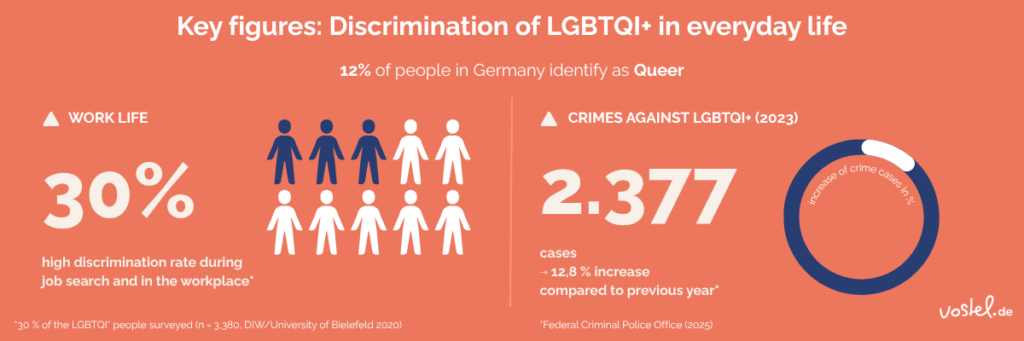
According to the LGBT+ Pride Study, about 12 percent of people in Germany identify as queer:
- 5 percent lesbian or gay
- 4 percent bisexual
- 1 percent transgender, nonbinary, or genderfluid
- 1 percent pan- or omnisexual
- 1 percent are asexual.
Legally, there have been significant changes in recent decades: The so-called “gay paragraph,” Section 175, which criminalized sexual acts between men, was not fully repealed until 1994. Nevertheless, for many queer people, social reality remains marked by discrimination.
Discrimination and hate crimes are on the rise
In 2025, police nationwide recorded 2,377 hate crimes against queer people—a new record high and a 12.8 percent increase from the previous year. In addition, queer people also face structural discrimination. About 30 percent report experiencing discrimination in the workplace; among trans* people, the figure is even over 40 percent. In the healthcare sector, 15 percent of respondents felt they were discriminated against last year.
Particular Challenges for Queer Youth
Young queer people are particularly affected. A study on the living conditions of queer youth in Bavaria shows that nearly half of 13- to 24-year-olds had suicidal thoughts in the past year. This is often due to what is known as “minority stress”: constantly having to deal with discrimination, rejection, or the fear of it leads to increased psychological strain.
As another study by the German Youth Institute shows, the overall conditions for this have improved significantly over time: While nearly half of today’s 15- to 17-year-olds feel supported in school, only 7 percent of those over 40 report having received support during their own school years. This shows just how much schools and society have changed for the better for queer youth in recent decades.
Social acceptance remains ambivalent
73 percent of Germans believe that lesbian, gay, and bisexual people should be protected from discrimination. For transgender people, the figure is 70 percent. However, only one in two people supports concrete legal measures. This gap between general agreement and political implementation shows that legal protection alone is not enough as long as it is not supported by a broad social consensus.
This is exactly where volunteer work comes in—it provides direct support and visibility for queer people, regardless of how far the political debate has progressed.
2. How Organizations and Volunteers Support the LGBTQI* Community
Key Organizations and Structures
Volunteer work has a long tradition in the queer community, as many organizations—from counseling centers and community centers to self-help groups—were established through civic engagement. The LSVD+ (Association for Queer Diversity) is Germany’s largest non-governmental LGBTQI* rights organization and is active nationwide through its state chapters. Much of its work is carried out by volunteers. In addition, there are numerous local associations, CSD organizations, and educational projects such as the SCHLAU initiatives, which provide education on sexual and gender diversity in schools.
The Role of Volunteers
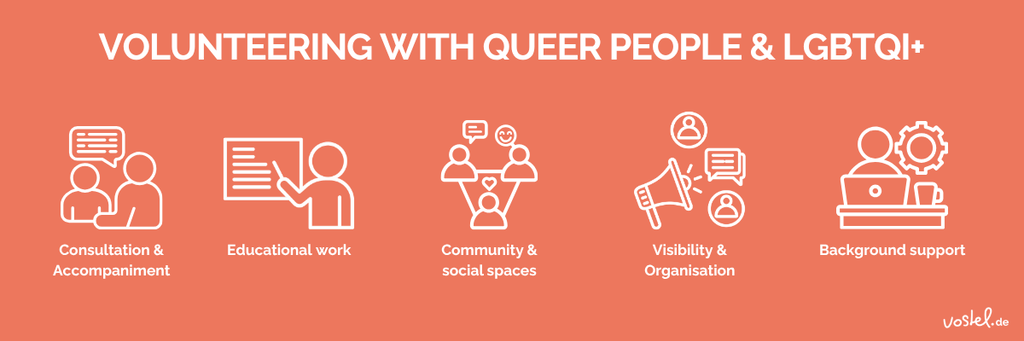
Volunteers take on a wide variety of tasks in this area:
Behind-the-scenes support: administrative assistance, fundraising, or expert support (e.g., legal advice) for queer organizations
Counseling and Support: Providing assistance at counseling centers or as a mentor, for example, to queer refugees
Educational Initiatives: Conducting workshops on sexual and gender diversity in schools
Community and gathering spaces: Getting involved in queer youth groups, meeting places, or networks such as Lambda that foster exchange and solidarity
Visibility and Organization: Co-organizing CSD events and demonstrations, public relations, social media, or event planning for queer organizations
3. What to Keep in Mind When Volunteering with Queer People

You don’t have to be part of the community yourself
A common misconception is that only queer people can get involved in the community. In fact, outside supporters—known as allies—are an important part of the movement. What matters most is your own attitude: listen attentively, reflect on your own biases, and give the community the space to speak for itself, rather than putting your own perspective front and center.
Sensitivity and Confidentiality
Tact is especially important when working with queer youth or refugees. Topics such as coming out, gender identity, or experiences as a refugee are often linked to personal experiences that can be emotionally taxing. Volunteers should therefore pay special attention to confidentiality and should not pressure anyone to come out or share information without being asked.
One-time involvement or long-term support
How much time you want to commit and what level of commitment you’d like to make is entirely up to you. Supporting a CSD or a demonstration is usually short-term and low-commitment. Mentoring or counseling programs, on the other hand, often lead to a long-term relationship built on trust. Accordingly, these require a greater level of commitment, sometimes spanning several months.
Training and Prior Experience
For open-ended, one-off volunteer opportunities—such as supporting Pride events or social media work—you usually don’t need any prior experience. For more sensitive tasks, such as counseling or support work, however, many organizations offer orientations, workshops, or training sessions—sometimes as a prerequisite for getting started. It’s best to check directly with the organization in question to find out what preparations are needed for the volunteer role you’re interested in.
4. Find a volunteer opportunity with LGBTQI* on vostel.de
Would you like to advocate for visibility, education, or direct support for queer people? At vostel.de, you’ll find opportunities to get involved with and for the LGBTQI* community throughout Germany.
5. FAQ – Frequently Asked Questions About Volunteering with Queer People
Why do queer people need special support in the first place? Isn’t there already equality?
Legally, a lot has changed in Germany, but socially, the reality remains mixed. Queer people continue to face discrimination in everyday life, in the workplace, and in the healthcare system, and anti-queer crimes are on the rise. Volunteer work addresses precisely these gaps.
What exactly do volunteers do in this field?
This ranges from helping out at CSD events to educational work in schools to providing counseling and support—for example, to queer refugees. It also includes organizational tasks such as public relations and social media.
Do I have to be part of the queer community myself to get involved?
No. You can also get involved as an ally—that is, as an outside supporter. Above all, it’s important to have an open, thoughtful attitude.
What is an “ally,” and how do I become one?
An ally is a person who shows solidarity with the queer community without being a part of it themselves. This means listening, questioning one’s own biases, and making space for others rather than putting one’s own perspective first—but it also means proactively advocating for the rights of queer people, for example by addressing discrimination in one’s own circle or getting actively involved.
What is the difference between participating in CSD events and long-term volunteer work, such as counseling or mentoring?
CSD support is usually time-limited and low-threshold, making it ideal for getting started. Counseling or mentoring, on the other hand, are based on a long-term relationship of trust and therefore require a greater level of commitment.
What should I keep in mind when volunteering to support queer youth or refugees?
Special sensitivity is required: Topics such as coming out or experiences as a refugee are often personal and emotionally taxing. Confidentiality is essential; no one should be pressured to come out or “outed” without being asked.
Do I need training or prior experience, for example, for counseling services?
For open formats such as CSD support, this is usually not the case. For more sensitive tasks such as counseling or support, many organizations offer introductory sessions or training, sometimes as a prerequisite.
How can I identify reputable, well-established organizations in this field?
Established organizations such as LSVD⁺ or local groups that have been active for many years are a good place to start. Make sure the organization is transparent about its goals and methods, and check whether it designates clear points of contact for volunteers.
What exactly do the abbreviations LGBTQI* and LSBTIQ* mean?
LGBTQI* stands for lesbian, gay, bisexual, transgender, queer, and intersex; the “+” includes other gender identities and sexual orientations. LSBTIQ* is the common German-language term for lesbians, gay men, bisexuals, transgender and intersex people, as well as queer people.
Discover more articles from our #VolunteeringExplained series
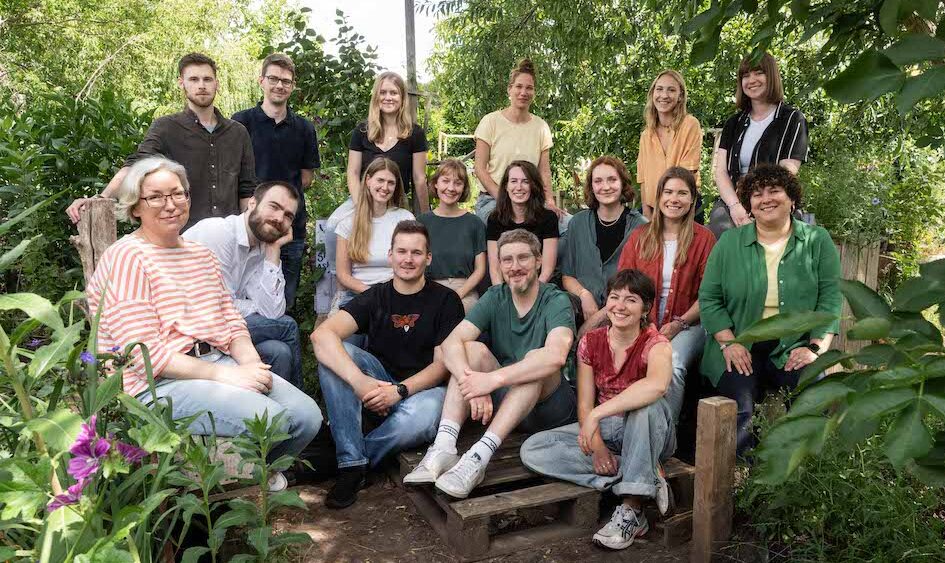
The vostel.de team wishes you a rewarding volunteer experience working with queer people!

No Comments yet!