
Volunteering in Mentoring Programs: What to Expect
As a volunteer in a mentoring program, you support people by providing regular guidance tailored to their individual circumstances. This could include children and teens on their educational journey, families who need a little help with everyday life, or newcomers who are learning a new language and trying to settle into a new society. As a mentor, you can become a supportive figure in the life of one of these people.
In this article, you’ll learn exactly what mentoring means, what responsibilities it entails, and how organizations can support you in the role as a mentor. We’ll also show you what to keep in mind as you get involved and how to find the right mentoring project for you on vostel.de.
Contents:
- Mentoring in Germany
- How organizations and volunteers facilitate mentoring
- What to look for in a mentoring program
- Find a volunteer opportunity in mentoring on vostel.de
- FAQ – Frequently asked questions about volunteering in mentoring programs
1. Mentoring in Germany
What Sponsorship and Mentoring Mean
Mentoring refers to long-term support provided to individuals or families to assist them in their particular life circumstances. The goal and process of such support always depend on the needs of the person receiving it and are usually agreed upon on a case-by-case basis.
The focus is usually on providing support in everyday life and spending free time together. Mentoring can also be tied to a specific topic, such as education, career guidance, language support, or the transition to vocational training or college.
Who would benefit from a mentoring program?
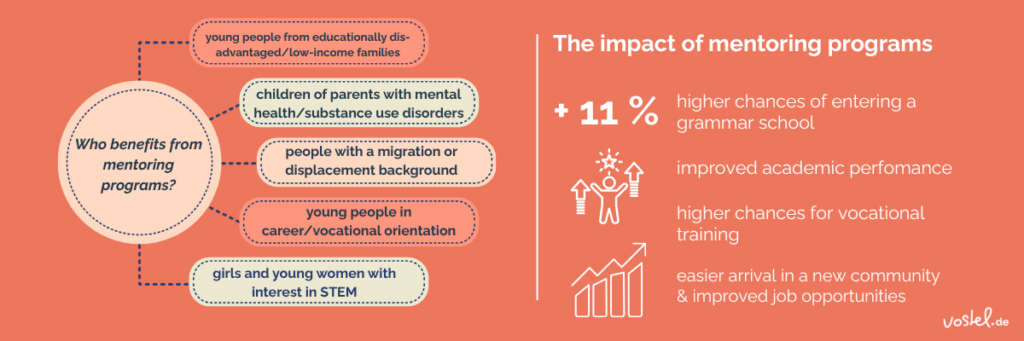
Every young person needs a different kind of support. A mentoring program is particularly valuable for these groups:
- Young people from families with limited educational opportunities or low incomes: In Germany, educational success unfortunately still depends heavily on one’s family background. As a result, children from households where neither parent has a college degree have only a 16.9% chance of attending a Gymnasium (grammar school). Mentoring can help them pursue a successful educational and career path despite these challenges.
- Young people with parents who have mental health issues or substance use disorders: According to estimates, approximately 3–4 million children in Germany grow up with a parent facing such challenges. As a result, they often have to take on household responsibilities at an early age and face a three- to fourfold increased risk of developing mental health issues themselves. A mentoring relationship creates a safe space outside the family where they do not have to take on responsibilities and have a reliable adult mentor by their side.
- Families facing particularly challenging circumstances: Single parents and families with newborns, in particular, benefit from personalized support in their daily lives. A mentoring relationship can provide relief during stressful daily routines, whether through practical help, a listening ear, or simply an extra pair of hands.
- People with a displacement or migration background: Since settling into a new country is often a challenge, mentoring programs can provide relief and support. They can help people find their bearings in their new daily lives, improve their language skills, foster genuine interaction, and build a local network.
- Teens and young adults choosing a career or college major: During the transition from high school to vocational training, college, or a career, mentoring can help them recognize their own strengths and find the right path.
- Girls and young women interested in STEM subjects: Mentoring programs can introduce them to real-life role models in mathematics, computer science, natural sciences, and technology, and encourage them to pursue careers in these fields.
Why mentoring is important
A study of the Balu und Du program shows that after one year of mentoring, elementary school children from low-income families were 11 percent more likely to attend a high school. Similarly, a study by the ifo Institute on the “Rock Your Life!” program found that mentoring led to improved academic performance among adolescents and a higher likelihood of them beginning vocational training.
Mentoring also has a significant impact on supporting people with refugee backgrounds: A study by DIW Berlin on the “Start with a Friend” program found that, after one year, refugees with mentors had significantly better German language skills and were more socially active than refugees without mentors. Mentoring can therefore tangibly improve the opportunities for socioeconomically disadvantaged young people.
2. How organizations and volunteers facilitate mentoring

What non-profit organizations do
In Germany, mentoring programs are typically run through organizations. These are responsible for selecting and training volunteers, matching mentors with mentees, and providing ongoing support throughout the mentorship. This provides reassurance to both the volunteers and the families and ensures that the pairs are a good match.
Well-known organizations in this field include, among others:
- Start with a Friend e.V.: Pairings between people with and without refugee backgrounds.
- Balu und Du e.V.: A nationwide mentoring program in which adults (“Balus”) regularly mentor elementary school children for one year.
- Rock Your Life! e.V.: Mentoring for young people transitioning from school to vocational training or college.
- StudyTutors e.V.: Volunteer tutoring and educational mentorship for children and teens.
- SkF (Catholic Women’s Social Service): Mentorship programs specifically for children of parents with mental health issues or substance use disorders.
- wellcome: Family mentorships that provide support to new parents during the first few months after the birth.
How volunteers are involved
As a mentor, you’ll usually meet with your mentee on a regular basis—often weekly or every two weeks. What you actually do depends on the program and the person’s needs. This might include, for example, playing games together, helping with homework, talking about career choices, or simply spending time together in everyday life. The organization supports you throughout this process with orientation sessions, designated contacts, and regular communication with other volunteers.
Volunteer opportunities in mentoring
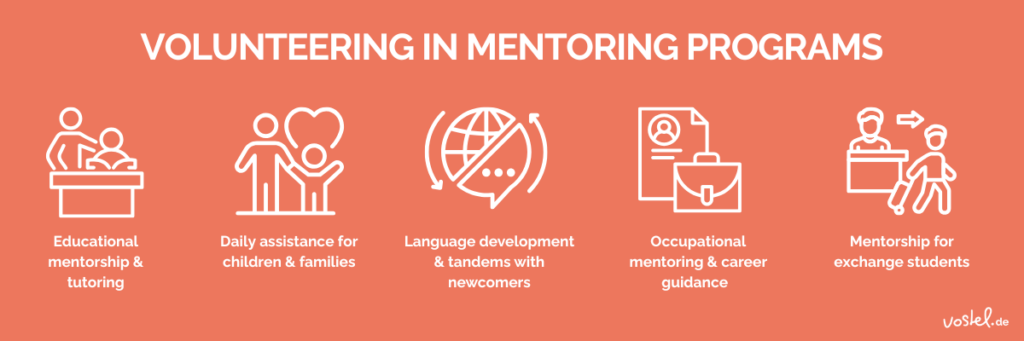
Mentoring programs come in many forms and are aimed at various target groups. On vostel.de, you’ll find the following opportunities, among others:
- Educational mentorships and tutoring: For children and teens who would like support with their studies and at school
- Day-to-day support for children and families: for families facing particularly stressful situations, as well as for children of parents with mental health issues or substance use disorders who need a reliable caregiver
- Language support and tandem partnerships with Newcomers: For people with displacement or migration backgrounds who are looking to find their bearings in their new daily lives and want to improve their language skills, including, for example, refugee children in your neighborhood
- Career guidance for young people: Mentoring to support the transition from school to vocational training, college, or a caree, for example, for girls interested in STEM subjects or for young people from families without an academic background
- Mentorships for exchange students: as a host family or contact person
3. What to look for in a mentoring program

Reliability is everything
Mentoring thrives on continuity, so think realistically in advance about how much time you can commit in the long run and communicate that openly with the organization. Here, cancelled or rescheduled meetings carry more weight than in other volunteer roles, because children from difficult backgrounds, in particular, often struggle when adults don’t stick to what’s been agreed upon.
Keeping your role clear
You are a mentor, not a parent, teacher, or therapist. This clarity protects you, your mentee, and the strength of your bond. The organization provides you with a framework for this and supports you when you’re unsure.
Trust needs time
A deep connection doesn’t form right away. Especially at the beginning, it can take time for a child or teenager to open up. To build a healthy relationship, it’s important to consciously manage closeness and distance, even as personal topics come up in conversations over time.
Sincerity over experience
You don’t need to have any formal training in education. It’s more important that you are patient and reliable, and that you’re willing to engage with different realities of life, whether they involve different family backgrounds, cultural influences, religion, or special challenges.
Safety for everyone involved
Since many mentoring programs involve children and teenagers, most organizations require an extended criminal background check and have clear safety protocols in place. This ensures the children’s safety and, at the same time, builds trust in you as a volunteer.
If the match isn’t right
Not every match works out right away. If the chemistry between you and your mentee isn’t right, that doesn’t mean you’ve failed. Many organizations offer the option to be rematched; feel free to contact a representative.
Making use of the organization’s support
Reputable organizations will support you throughout the entire program, offering opportunities to meet with other volunteers and providing designated contacts to help with questions and difficult situations. Take advantage of these resources, they’ll help you make the most of your volunteer experience over the long term.
You can find more tips on volunteering with children, teens, and families in our articles “Volunteering with Children & Teens ” and “Volunteering with Families.”
4. Find a volunteer opportunity in mentoring on vostel.de
Would you like to be a reliable support person for a child, a teenager, a newcomer, or a family? On vostel.de, you’ll find numerous mentoring projects throughout Germany: from educational and family mentorships to mentoring for people with refugee backgrounds. Filter by location, time commitment, and target group to find a volunteer opportunity that fits into your daily life.
5. FAQ – Frequently asked questions about volunteering in mentoring programs
What is mentoring?
Mentoring describes a personal, long-term one-on-one support relationship in which the focus can either lie on everyday support and spending free time together, or on a specific topic such as education or career guidance.
How much time do I have to schedule in for mentoring ?
It depends on the program; usually, you’ll meet once a week or every two weeks for one to two hours. More important than the exact number of hours is that you realistically consider how much time you can commit on a long-term basis, because reliability is especially important in this type of volunteer work.
Do I need specific qualifications to become a mentor?
No. For most programs, you don’t need any teaching training or prior experience. What’s important is patience, reliability, and an open mind toward a different way of life. The organizations will prepare you for your volunteer work with orientation sessions or training.
How does the entry process into mentoring work?
An initial interview with the organization is usually followed by a meeting to get to know the child or family, often accompanied by full-time staff members. When working with children, an extended criminal background check is also generally required.
How long does a mentorship last?
Most programs are designed to last at least one year, some can last significantly longer. This continuity is important for building trust.
What if the chemistry between the child and I is not right?
This can happen, and it’s no reason to feel bad. Talk about it openly with your contact person in the organization; many programs will then arrange a new match.
Does mentoring actually have an impact?
Yes, several studies confirm this. Programs such as Balu und Du and Rock Your Life! have been shown to improve educational opportunities and academic performance among the children and adolescents they support.
Can I do this alongside my job or studies?
Yes. Most mentoring roles require only a few hours a week or a month, so they’re easy to balance with daily life, work, or school.
How can I find a fitting project near me?
On vostel.de, you can filter your search by location, target audience, and time commitment, and contact the right organization directly.
Discover more articles from our #VolunteeringExplained series
Your vostel.de team wishes you valuable experience in volunteering in mentoring programs!



No Comments yet!