
Volunteering in education & language support: what you can expect
Tutoring in the afternoon, a language café on Tuesday evenings, homework supervision after school: volunteering in education and language support is as diverse as the people who benefit from it. And the need is real. In Germany, educational success still depends heavily on the parental home and for many refugees and immigrants, language is the biggest hurdle on the way to work and social participation.
Volunteers are very important here, whether as tutors, language tutors, homework help or training mentors. You don’t need a teaching degree to do this, but above all time, reliability and an interest in people. We’ll show you what you can expect.
Contents:
- Education & language support in Germany
- How organizations and volunteers strengthen educational opportunities
- What you should look out for when volunteering in education & language support
- Find your volunteer position in education & language support on vostel.de
- FAQ – Frequently asked questions about volunteering in education & language support
1. Education & language support in Germany
Social background still determines educational path
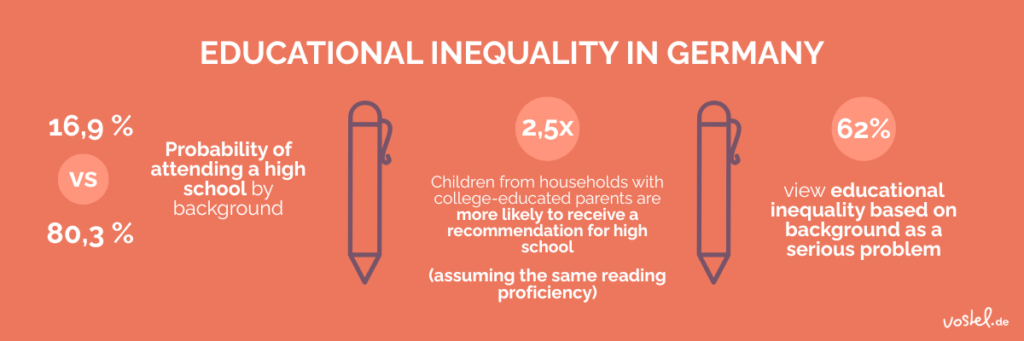
Education is considered one of the most important levers for a self-determined life. However, the educational success of children and young people in Germany still depends heavily on the home they grew up in. This is clearly shown by the current ifo Opportunity Monitor 2026:
- Children from educationally disadvantaged, low-income families are only 16.9 percent likely to attend a grammar school.
- For children from high-income families with a high school diploma, this figure is up to 80.3 percent.
- This corresponds to a spread of almost 64 percentage points, depending on which family a child is born into.(ifo Institute / A Heart for Children, Opportunity Monitor 2026)
Influence of social background particularly strong in Germany
The German education system is one of the OECD countries in which social background has a particularly strong influence on educational attainment. Only 20 percent of children from educationally disadvantaged households achieve a higher educational qualification, compared to 60 percent of children from academic families.(OECD, Education at a glance 2025)
Of all the participating OECD countries, Germany therefore has the largest performance gap between young adults with and without higher education qualifications.
Language as the key to participation for newcomers
Alongside educational inequality, language support is a second key issue. For many refugees and immigrants, German is not just a foreign language, but the prerequisite for almost everything: finding an apartment, starting a job, dealing with the authorities, supporting children at school.
However, not everyone has access to state integration courses. Those who are still in the asylum process or come from a so-called safe country of origin are excluded from many official courses. Further cuts were also decided at the end of 2024(Mediendienst Integration, 2025). For this reason, voluntary language courses and language cafés are often the only low-threshold opportunity to learn and practise German.
Education is also important at an older age
Educational inequality does not only affect children and young people. Many adults and senior citizens have also had little access to education in the course of their lives or are now facing new challenges: the digitalization of everyday life, changing working conditions or the desire to explore new topics and skills in retirement.
Adult education centers, libraries and non-profit associations offer a lot here, but are dependent on volunteers to accompany courses, support individuals or simply act as learning partners. There is a growing need for basic digital skills in particular, i.e. how to use a smartphone, deal with the authorities online or make video calls, while full-time staff are often unable to keep up.
2. How organizations and volunteers strengthen educational opportunities

What non-profit organizations do
There is a vibrant landscape of associations, initiatives and platforms in Germany that are committed to greater educational equality and better language support. Many projects are anchored locally and know exactly what is needed on the ground. Others work nationwide, in some cases completely digitally.
- Support for newcomers: Organizations offer language support, everyday integration and digital qualifications for refugees and immigrants. Well-known contact points include Start with a Friend e.V., the ReDI School of Digital Integration and language cafés run by various organizations such as AWO, Malteser Hilfsdienst and Kiezspinne Berlin.
- Support for children and young people: Whether it’s free tutoring, reading mentorships or mentoring at the transition from school to work, numerous organizations are targeting areas where the school system leaves gaps. Among others, StudyTutors e.V., Lern-Fair e.V., Schülerpaten Berlin e.V., KinderHelden gGmbH, Balu und Du e.V., Rock your Life e.V. and Joblinge are active in this area.
- Digital education and career guidance: Some initiatives have specialized in digital skills and entry into the world of work, especially for young people from disadvantaged backgrounds. The Hacker School gGmbH and the Imagine Foundation, among others, are active in this area.
How volunteers are involved
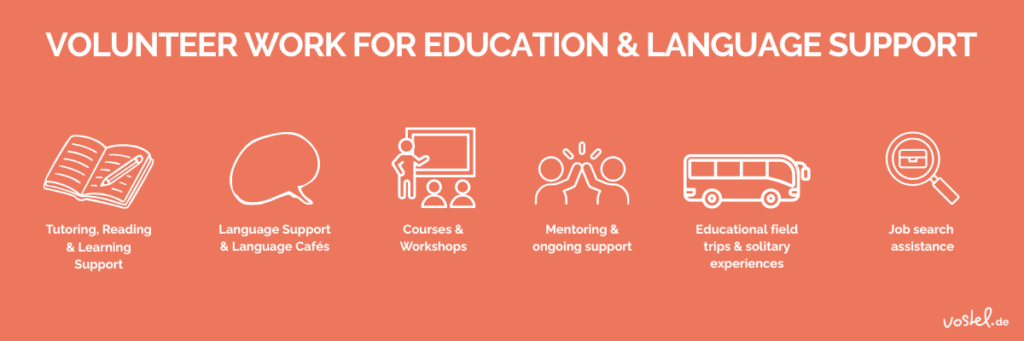
Whether in your city or from the comfort of your own home: There are a wide range of opportunities to get involved in education and language support. On vostel.de you will find the following activities, among others:
- Tutoring, reading and learning support for children and young people, on site or via video call, from homework help to reading mentors
- Language support & language cafés for refugees and immigrants, in courses, as a tandem or in open discussion groups
- Courses & workshops on digital skills, programming or everyday topics, for children, women, refugees and senior citizens
- Mentoring & regular support for pupils and newcomers at the transition from school to training and work
- Educational excursions & shared experiences such as museum visits, city tours or intercultural events
- Job search support for young people, women and newcomers entering the German labor market
What you achieve with it
As a volunteer in education and language support, you don’t just pass on knowledge. You create trust, are a reliable contact person and open up paths that might have remained closed without you. With your volunteer work, you can help a child to succeed in their school transfer, a refugee to start their first job or a young person to find an apprenticeship.
As a volunteer, you do not provide professional social work and do not replace teachers. But you can create something that many structures alone cannot offer: reliable relationships, a sense of closeness and time for the individual. This is precisely what often has a real impact in education and language support
3. What you should look out for when volunteering in education & language support

Find out what’s right for you
Education and language support is not a clearly defined field. You don’t have to be a teacher or speak a second language to make a meaningful contribution. Think briefly about what you are good at and what you are confident in.
Those who enjoy working directly with children may find themselves in homework supervision or tutoring. Those who prefer to come into contact with adults are in good hands at the language café or as a tandem partner. If you want to help regardless of location, you can provide digital support via platforms such as Lern-Fair. And if you want to support young people or newcomers on their career path, mentoring programs are a good place to start.
Set clear expectations from the start
Before you start, it is worth discussing openly with the organization what they expect from you and what you hope to gain from the commitment. How often can you come? Will there be an introduction or training? Who is your contact person if you have any questions?
Reliability is important
Clear agreements help both sides. Reliability is particularly important when working with children and young people or with people in difficult life situations.
Know your role
If you are involved in education and language support, you will sometimes encounter difficult realities of life. Refugee language learners have often experienced trauma. Children from troubled families sometimes bring more to the table than just homework.
This doesn’t have to put you off, but you should know that you are not a therapist and don’t have to be. Your job is to provide support, not to solve problems. Many organizations therefore offer introductions, discussion groups or contact persons for precisely such situations. Take advantage of these offers.
Realistically estimate the time required
Some commitments are one-off or project-related, such as a workshop or a vacation offer. Others require regular appointments over several months, for example a weekly tutoring session or a fixed tandem. When searching, look carefully at what rhythm suits your everyday life and only sign up for what you can actually do. For children and language learners in particular, continuity is often more important than intensity.
4. Find volunteer opportunities in education and language support on vostel.de
Whether it’s tutoring, language cafés, mentoring, or digital learning support: On vostel.de, you can find volunteer opportunities in education and language support that suit you, whether in your local area or from anywhere. Browse through hundreds of projects, filter by city, time commitment, and target group, and find the volunteer.
5. FAQ – Frequently asked questions about volunteering in the field of climate and nature conservation
Do I need a degree in education?
No. You don’t need any formal qualifications for most projects. What counts is reliability, patience and an interest in people. Many organizations offer a short introduction or training so that you start well prepared. Special requirements, such as certain language skills or an extended certificate of good conduct, can be found directly in the respective project description on vostel.de.
How much time should I set aside each week?
It depends on the project. Many commitments start with one hour per week, for example a tutoring session or a regular tandem meeting. Others are project-related or one-off, such as a workshop or a vacation program. On vostel.de, you can filter for the time model that suits your everyday life.
Can I volunteer from anywhere?
Yes, especially in the area of digital learning support, there are a growing number of projects that work completely online. Platforms such as Lern-Fair e.V. arrange tutoring tandems via video call so that you can support students all over Germany, no matter where you live. On vostel.de, you can restrict your search to location-independent offers.
What is a language café, and how does it work?
A language café is an open, informal meeting where people from different language backgrounds come together to practise German. There is no fixed teaching program: The focus is on everyday conversation, often on specific topics or during joint activities. As a volunteer, you are a conversation partner, give feedback and create a welcoming environment. You do not need any previous teaching experience.
What if I’m faced with difficult life stories?
This can happen, especially when working with refugees or children from troubled families. The important thing is that you are not alone in this. Reputable organizations will prepare you for this, have contact persons for such situations and make it clear where your role ends. You don’t have to have solutions for everything. Sometimes it’s enough just to be there reliably.
Discover more articles from our series #VolunteeringExplained
Your vostel.de team wishes you valuable experience in your voluntary work in education and language support!


No Comments yet!